Eurovision
A Reality Check on The French Wine Crisis
What is the state of the current crisis in the French wine industry? A combination of declining domestic consumption in many European countries, and 5-10% annual slide in exports have helped create surpluses which run into the billions of litres. Couple this with reports of crazed Languedoc winemakers brandishing pitchforks and rioting in the streets, and that a number of wineries are on the brink of bankruptcy, and one can’t help but sense a hint of desperation on the other side of the Atlantic. But is this actually the case or another example of sensationalized journalism?
The recent Salon des Vins gave me an opportunity to talk with a number of European, mostly French, winemakers. I had expected to encounter a sullen and desperate crew, battered and bruised after years of difficult vintages, falling sales and internal strife. What I did find however was an interesting dialogue that is beginning to develop within the industry. And while the particular visions may at times be quite divergent, there was a sense of optimism on the surface, and hints of change if one read between the lines. The full interviews will be coming at you later this summer (wink!).
If there was one common vision in all those I talked to it was the desire to maintain the existing appellation system. While most mentioned the need for more informative labeling (grapes used and percentage of the blend), the focus tended to rely more on effective marketing than moving towards single varietal wines, or eliminating many of the restrictions that are inherent in the AOC system. They still see their AOC as a brand, under-developed, but a brand nonetheless that needs to be commercialized better in the new world (I would suggest hiring more North American ad agencies and yes, many of those I talked to think Jerry Lewis is very funny).
That being said, the one recurring theme from all was the idea of ripeness. Whether or not this means changing the traditional French notion of ripeness towards one which approaches a new world model, that was not universal. However, the Rolland wines of Clinet and Clemence in Pomerol were remarkably juicy from 2001 big Bordeaux and one was hard-pressed to find a winemaker that didn’t emphasize the ripeness qualifier to describe their wines. Aside from ripeness, I noticed a subtle tendency towards more wood, especially in Chablis. Perhaps this is that oh so French way of adapting without adapting, you gotta love ‘em ( sort of).
Most noticeable was the emphasis placed on North American markets. If Bordeaux seems to be back on track with respect to its exports, it is largely due to us. However, how one should approach the emerging American wine drinker was far from universal. Tomas Perrin from Beaucastel in Chateauneuf was convinced that the recent downturn in French exports is cyclical, and that French wine will soon regain its dominance and thus few changes need to be made (however a new sanitary regime in the chais to remove all traces of Brett is perhaps a concession to New World Fruit-sters).
Others such as Ramos Pintos in the Duoro (Adriana) and the Languedoc’s Paul Mas (Arrogant Frog) have created bottlings solely for these export markets. These wines were described as fruity, modern, easy to drink and less expensive than their regular bottlings, however, neither was willing to talk much about how these wines were made. While I didn't get to see or taste the Ramos bottle, Mas' Frog was a beautiful satirical take on this animal label laden 'adventure' wine category).
(The Arrogant Frog was his response to the ‘Freedom Fryers’ call for a ban on French Wine. First put together as a bit of a joke, it has become the cornerstone of his exports to the New World markets).
So the word was ‘make allowances but don’t stray too far from tradition.’ There is the feeling that at least a portion of this emerging North American market will tire of the New World ‘verrry ripe’ style of wine. Whether or not this is the right approach, time will tell, but I did taste a number of really good Aussie and Californian un-oaked Chardonnays and many a cabernet and zinfandel much more restrained and far less oaked than I am accustomed to. Is it because they ran out of barrels or is the market already moving in that (I would say right) direction?
Wednesday, March 29, 2006

Monday, March 27, 2006
The Post-Salon Hangover
Well at least the shakes are starting to go away. Three days and nights of living wine have taken their toll but I am at least a bit wiser than I was this time last week. This year’s salon was an incredible success as I met a great (and incredibly polite) new friend, dozens of passionate winemakers, and a plethora of interesting and unique wines from the world over. And all it required was for you to offer up your glass, open your mind and mouth, and imagine the possibilities.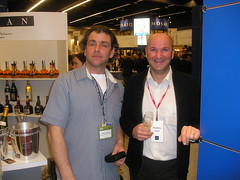
As I still have a bit of that ‘deer in the headlights’ feeling, here is a list of some of my most immediate impressions, interesting revelations and the only photo that I managed to take.
As exhibited by Jura winemaker Stephan Tissot (photo at right), the spirit of innovation and one’s fidelity to tradition need not be mutually exclusive. Coming soon, a red vin de paille made with Poulsard (inspired by many a great Italian reccioto). For more detail on Steph, check out Beau's take.
My favorite Chardonnay (at any price) was made by a Canadian Winery…Chardonnay 2003, Vintner’s Private Reserve, Peninsula Ridge ($50…importation). Go Canada!
Zinfandel can also be made with elegance and restraint …Zinfandel 2004, Joel Gott
According to Tomas Perrin, Chateauneuf’s famous Beaucastel is now 100% Brett free and due to their technique of ‘flash heating’ their grapes prior to fermentation, have almost eliminated the need to sulfur their wines.
Ferreira’s dry Douro reds have completely redefined the way that I look at Portuguese red wines. Barca-Velha 1995 ($102..saq) is comparable to many of the best reds that I have ever tasted and the Colheita 1996 ($39..importation) had a combination of spice and fruit that offered up the elegance of aged Bordeaux with the feistiness of many a great Rhone.
An expensive 2001 Michel Rolland Bordeaux does drink easier than a non-Rolland Bordeaux from the same vintage (Clinet and Clemence versus Cheval Blanc).
I have never met so many woman winemakers. From Yalumba in Australia to Taupenot-Merme in Burgundy, it seems that the gender gap is finally narrowing, and about time.
When nothing else will go down, drink Champagne.
We are all really lucky to work in an industry filled with such passionate and entertaining individuals.
Well at least the shakes are starting to go away. Three days and nights of living wine have taken their toll but I am at least a bit wiser than I was this time last week. This year’s salon was an incredible success as I met a great (and incredibly polite) new friend, dozens of passionate winemakers, and a plethora of interesting and unique wines from the world over. And all it required was for you to offer up your glass, open your mind and mouth, and imagine the possibilities.
As I still have a bit of that ‘deer in the headlights’ feeling, here is a list of some of my most immediate impressions, interesting revelations and the only photo that I managed to take.
As exhibited by Jura winemaker Stephan Tissot (photo at right), the spirit of innovation and one’s fidelity to tradition need not be mutually exclusive. Coming soon, a red vin de paille made with Poulsard (inspired by many a great Italian reccioto). For more detail on Steph, check out Beau's take.
My favorite Chardonnay (at any price) was made by a Canadian Winery…Chardonnay 2003, Vintner’s Private Reserve, Peninsula Ridge ($50…importation). Go Canada!
Zinfandel can also be made with elegance and restraint …Zinfandel 2004, Joel Gott
According to Tomas Perrin, Chateauneuf’s famous Beaucastel is now 100% Brett free and due to their technique of ‘flash heating’ their grapes prior to fermentation, have almost eliminated the need to sulfur their wines.
Ferreira’s dry Douro reds have completely redefined the way that I look at Portuguese red wines. Barca-Velha 1995 ($102..saq) is comparable to many of the best reds that I have ever tasted and the Colheita 1996 ($39..importation) had a combination of spice and fruit that offered up the elegance of aged Bordeaux with the feistiness of many a great Rhone.
An expensive 2001 Michel Rolland Bordeaux does drink easier than a non-Rolland Bordeaux from the same vintage (Clinet and Clemence versus Cheval Blanc).
I have never met so many woman winemakers. From Yalumba in Australia to Taupenot-Merme in Burgundy, it seems that the gender gap is finally narrowing, and about time.
When nothing else will go down, drink Champagne.
We are all really lucky to work in an industry filled with such passionate and entertaining individuals.
Monday, March 20, 2006
Salon des Vins de Montréal
2006 Version
This week is a special week for local winos as the salon des vins opens on Thursday March 23.
The salon offers the wine afficionado not only an opportunity to taste bottlings from the world over but more importantly a chance to meet the face behind the bottle. This is the rare opportunity.
So take care of your liver for the week, and be Zorba the dégustateur for a day. Get down to the salon... it really is a rare chance to gain a little more insight into the wonderful world of wine.
2006 Version
This week is a special week for local winos as the salon des vins opens on Thursday March 23.
The salon offers the wine afficionado not only an opportunity to taste bottlings from the world over but more importantly a chance to meet the face behind the bottle. This is the rare opportunity.
So take care of your liver for the week, and be Zorba the dégustateur for a day. Get down to the salon... it really is a rare chance to gain a little more insight into the wonderful world of wine.
Friday, March 17, 2006
Matching Food and Wine
To my knowledge, we are the only animal that drinks while eating; once again, lucky humanoids! I am not sure when this transition happened, but one amongst my ancestral namesakes decided that perhaps a goblet of water diluted ‘bronto blood’ might be a refreshing accompaniment with his giant turtle brochette. Quelle idée.
Now, fast forward to pre-jesus times and our first wines. Even then I am sure that there were all types of drinkers. This list includes the casual drinker who isn’t too picky about what’s in his or her glass, to those who seeked out the best and most interesting cuvees, to the ‘Caligulites’ who simply wanted to get blasted prior to the evenings orgy. Well, times haven’t changed all that much.
I started as a type 1 drinker, but have evolved into a real type 2 (probably with deep-seeded fantasies of being a type 3). But more importantly, I have come to look upon wine as an accessory to my meal. Good wine and food will always be that, but the experience is doubly fun when the two work together in harmony. This is the area of wine appreciation that freaks most people out and interestingly enough, what drives most new readers to this site (and the occasional 5:00 emergency phone call). But relax, there is a logic here. I have baptized next week as food and wine week here in caveman land, and to begin it in grand Friday style….
The RossoRosso Chicken with a Sweet Spice Grape Salsa (the acidity tune-up)
So with a ‘grapey’ Fruili merlot opened and drinking well, I had to figure out something to do with the chicken breasts. I had the idea of a warm red grape salsa, but needed a bit of help with the spicing. So a quick call to l'eau and chef Phil hel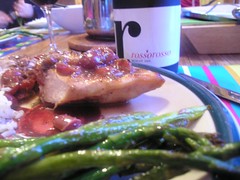 ped refine the concept.
The key was the sauce as chicken breasts, well, can be the most innocuous of meats. Our Merlot had a very bright fruit profile, bordering on slightly candied dark plums, with a hint of sweet spice on the finish. I wanted the sauce to add some depth to the fruit, but mostly I wanted flavor and depth from the spices. The result was exceptional and took a wine that at first I found a bit thin, with just a bit too much acidity for it’s body (another case of the weak 2002 vintage), and turned it into a wonderful compliment.
The key was that the natural acidity of the grapes were a touch more than what I had in the wine. This had the effect of ‘flattening’ out the wine, in effect, negating it's acidity. Try drinking some acidy juice like apple juice and then drink it after you bite into a lemon, you'll see what I mean. Next post, when you want more acidity in your glass than on your plate.
Sauce
Grapes (cut in half)
Ground roasted fennel, coriander and cardamom seeds
Spring onions
Salt and pepper
I warmed the grapes with a bit of grapeseed oil until they became soft. Deglazed with a bit of the merlot and some chicken stock, Added a tablespoon of my spice mix, the spring onions and let it reduce (making sure the grapes stayed intact). Finish with salt and pepper.
Serve with broiled chicken breasts, cloved rice and roasted asparagus.
Colli Orientali del Friuli 2002, Rossorosso, Banear ($20…saq)
To my knowledge, we are the only animal that drinks while eating; once again, lucky humanoids! I am not sure when this transition happened, but one amongst my ancestral namesakes decided that perhaps a goblet of water diluted ‘bronto blood’ might be a refreshing accompaniment with his giant turtle brochette. Quelle idée.
Now, fast forward to pre-jesus times and our first wines. Even then I am sure that there were all types of drinkers. This list includes the casual drinker who isn’t too picky about what’s in his or her glass, to those who seeked out the best and most interesting cuvees, to the ‘Caligulites’ who simply wanted to get blasted prior to the evenings orgy. Well, times haven’t changed all that much.
I started as a type 1 drinker, but have evolved into a real type 2 (probably with deep-seeded fantasies of being a type 3). But more importantly, I have come to look upon wine as an accessory to my meal. Good wine and food will always be that, but the experience is doubly fun when the two work together in harmony. This is the area of wine appreciation that freaks most people out and interestingly enough, what drives most new readers to this site (and the occasional 5:00 emergency phone call). But relax, there is a logic here. I have baptized next week as food and wine week here in caveman land, and to begin it in grand Friday style….
The RossoRosso Chicken with a Sweet Spice Grape Salsa (the acidity tune-up)
So with a ‘grapey’ Fruili merlot opened and drinking well, I had to figure out something to do with the chicken breasts. I had the idea of a warm red grape salsa, but needed a bit of help with the spicing. So a quick call to l'eau and chef Phil hel
ped refine the concept.The key was the sauce as chicken breasts, well, can be the most innocuous of meats. Our Merlot had a very bright fruit profile, bordering on slightly candied dark plums, with a hint of sweet spice on the finish. I wanted the sauce to add some depth to the fruit, but mostly I wanted flavor and depth from the spices. The result was exceptional and took a wine that at first I found a bit thin, with just a bit too much acidity for it’s body (another case of the weak 2002 vintage), and turned it into a wonderful compliment.
The key was that the natural acidity of the grapes were a touch more than what I had in the wine. This had the effect of ‘flattening’ out the wine, in effect, negating it's acidity. Try drinking some acidy juice like apple juice and then drink it after you bite into a lemon, you'll see what I mean. Next post, when you want more acidity in your glass than on your plate.
Sauce
Grapes (cut in half)
Ground roasted fennel, coriander and cardamom seeds
Spring onions
Salt and pepper
I warmed the grapes with a bit of grapeseed oil until they became soft. Deglazed with a bit of the merlot and some chicken stock, Added a tablespoon of my spice mix, the spring onions and let it reduce (making sure the grapes stayed intact). Finish with salt and pepper.
Serve with broiled chicken breasts, cloved rice and roasted asparagus.
Colli Orientali del Friuli 2002, Rossorosso, Banear ($20…saq)
Wednesday, March 15, 2006

Stop Drinking Cheap Corporate Wine!
Tom pointed to an ‘interesting’ article written by Jennifer Rosen defending ‘corporate’ wine. Defending it against whom I am not sure but the crux of her argument posits that this inexpensive ‘corporate’ wine, which is as familiar and as regular in quality as toothpaste, brings more drinkers into the marketplace. In the same breath, she seems to characterize those drinkers who expect more from their wines as neophytes and epiphany seekers, while the ‘clueless masses’ seem to want some sort of ‘bland’ drink that is as ‘reliable and cheap’ as Coke (quality notwithstanding). To paraphrase a paraphrasing blog buddy, her logic seems to suggest that to make wine accessible we must have more shit wine available. Oh those poor, stupid, taste-deficient masses.
Well, wine is not coke. Unfortunately, there seems to be some underlying sentiment amongst certain in the industry to treat it as such; just another spoke in the wheel of the beverage industry. Perhaps I am being nostalgic and sentimental, but I still want my wine to be made by someone who grew and pressed his own grapes, and whose wine ultimately carries his signature and some sense of place. It might be quaint but there is more often than not a measure of authenticity about the final product that differentiates it from the yellow tails, little penguins, and other mass-produced, ‘brand’-oriented wines that fill supermarket shelves. Rosen makes the point that many of these more ‘artisanal wines’ are ‘perfectly dreadful,’ but on the whole I would disagree and find most of these wines more interesting, and at least not disgusting.
I have tried these price-point wines on a number of occasions. I am usually unimpressed, sometimes horrified and rarely surprised. My most recent foray into what Ms. Rosen refers to as ‘corporate wines’ was a tasting of Southcorp (Foster’s) ‘Little Penguin.’ The Chardonnay reminded me more of coconut tanning lotion than white wine, and the Shiraz was closer to Robitussin (without that excellent muted buzz). But this is a question of personal taste. I neither buy nor drink these penguin wines, as I won’t most of the cheap wines presently on the market. This is not because they are made by some massive, unfeeling corporate monolith. It is simply because they taste bad.
But, as children who were raised to believe that garlic-flavored popsicles are good, Rosen claims her ‘blandies’ expect nothing more than the ‘Tzatziki pop’ of wine and are thus happy and comfortable in their ignorance.
This is bullshit. It is rare that I have not been able to take a person who has drunk only cheap wine and showed them that, for a few dollars more, there is a better option. And the majority of the time, they can taste the difference. Ultimately it is a question of priorities. It isn't that different from spending that extra 20% on organic produce, for it too is often better than the cheaper industrial produce which fills the aisles of your local supermarket. It just so happens that these super-cheap wines, which are made affordable because of the economy of scale, are often below the threshold of what smaller wineries can afford to produce. I will not even get into how they are made. But for a few dollars more (at least here in Quebec), there exist a plethora of interesting wines from the world over, many made by co-operatives and good, independent winemakers. By supporting these smaller producers, we are supporting diversity, independence, and frankly they need the cash more than the big corps.
The reality of the modern wine industry is that there are fewer and fewer independent winemakers. Cheval Blanc, Etude, Ornellaia, Yquem, Penfolds, Coldstream and a vast majority of the better wine producers worldwide are now part of corporate portfolios. Like in any industry, there are good corps and bad ones. Those which recognize and continue to support the ‘artistry’ of winemaking and have not become complacent with quality deserve our continued support. Ms. Rosen’s characterization of corporate wine as cheap wine is an insult to many of the better corporations which continue to produce great wines. Her article should have been entitled ‘in defense of cheap, mass-produced wine,’ but even then, I don’t agree.
The real danger of the big corps with large alchohol and wine portfolios lies more in the distribution end of the industry. It is here where smaller producers and distributors face increasingly difficult challenges and it is here that they need our support. So get off the kangaroo, seek out the independents and ultimately tell your friends to spend a bit more for their bottles, you will be doing both the industry, and your friends, a lot of good.
Friday, March 10, 2006
The Importance of Blog
A recent post by Tom at Fermentations compared his disillusionment with baseball as a result of the Barry Bonds steroid scandal with that of jaded wine lovers, who having been routinely disappointed by the plethora of banal ‘industrial’ wines out there, have become ‘authenticity’ snobs. This begets an exposé about how we define authenticity, the notion of ‘naturalness’ and ultimately the relationship between these principles and how a wine can most genuinely represents a time, a place, and the soul of the person who makes it. This post has been in the works for a couple of weeks now and is turning my brain to jello, but it is coming.
So I decided to look at the situation from another perspective. I am in a privileged position in that I talk regularly to winemakers, importers and agents, and thus have access to both information and wines that the majority of the public do not. In a weird way, this knowledge is at the root of both my snobbism and somewhat ‘cynical’ perspective of the present day wine world.
I see the ‘yellow tails’ and ‘little penguins’ eating up market share like boozy pacmen. I see wines being ‘constructed’ to please the tastes of a small clique at the expense of the expression of a time, place and soul. I see a consolidation of distribution and retail forcing many of the wines that I love to the back of the shelves or they are simply not on the shelf at all. I see an increased interest from my demographic in wine, but all too often their sources of information and education are poorly informed or completely out to lunch retailers. And most importantly, I see a mainstream wine media that does little to trumpet authenticity and diversity.
So I spent a day reading through a number of wine blogs yesterday and was awed by the breadth of information and passion that was out there. For those of you who feel sometimes that all the time and effort that you put into your writing is for not, remember that the revolution will take time. Many of our voices are beginning to be heard, and as more and more ‘regular’ folk seek out alternative sources of information, the foundation of archived information that we are building will be read.
What we are doing is important. Have a great weekend and drink well.
A recent post by Tom at Fermentations compared his disillusionment with baseball as a result of the Barry Bonds steroid scandal with that of jaded wine lovers, who having been routinely disappointed by the plethora of banal ‘industrial’ wines out there, have become ‘authenticity’ snobs. This begets an exposé about how we define authenticity, the notion of ‘naturalness’ and ultimately the relationship between these principles and how a wine can most genuinely represents a time, a place, and the soul of the person who makes it. This post has been in the works for a couple of weeks now and is turning my brain to jello, but it is coming.
So I decided to look at the situation from another perspective. I am in a privileged position in that I talk regularly to winemakers, importers and agents, and thus have access to both information and wines that the majority of the public do not. In a weird way, this knowledge is at the root of both my snobbism and somewhat ‘cynical’ perspective of the present day wine world.
I see the ‘yellow tails’ and ‘little penguins’ eating up market share like boozy pacmen. I see wines being ‘constructed’ to please the tastes of a small clique at the expense of the expression of a time, place and soul. I see a consolidation of distribution and retail forcing many of the wines that I love to the back of the shelves or they are simply not on the shelf at all. I see an increased interest from my demographic in wine, but all too often their sources of information and education are poorly informed or completely out to lunch retailers. And most importantly, I see a mainstream wine media that does little to trumpet authenticity and diversity.
So I spent a day reading through a number of wine blogs yesterday and was awed by the breadth of information and passion that was out there. For those of you who feel sometimes that all the time and effort that you put into your writing is for not, remember that the revolution will take time. Many of our voices are beginning to be heard, and as more and more ‘regular’ folk seek out alternative sources of information, the foundation of archived information that we are building will be read.
What we are doing is important. Have a great weekend and drink well.
Wednesday, March 08, 2006
WBW – Rhone Varietals
And The Search for the Perfect Pasta
I must admit to being completely surprised last night when I realized that today was the due date for the latest installment of Lenn’s Wineblog Wednesday. Being completely unprepared, and with super chef Nancy coming over for a fresh pasta lesson, I rummaged through the cellar looking for a bottle of Rhone. Aside from some pretty racy 1999 Vieux Telegraph which I was sure would have been way too powerful with our unplanned meal (the equivalent of shooting my cat with an elephant gun), the cellar was Rhone-less.
But I did come across two Australian bottles which were Rhône varietals, both from the house of D’Arenberg so I hope that it counts. So here are the reviews against the backdrop of a pretty successful pasta meal. Thanks for doing the hostin’ Jathan.
The Kneading Wine
Rousanne e 2004, The Money Spider, McLaren Vale, D’Arenberg ($23…ip...buy it)
This was my first taste of Rousanne outside of the Rhône and was quite surprised. It is named after an infestation of the Money Spider (Erigoninae for you Arachnologists out there) which ruined their first supposed vintage in 2000. Local folklore claims that kindness to these bugs brings both happiness and good fortune so the good folks at D’Arenberg decided to let the spiders have their run at the Rousanne and waited an extra year before making their first vintage. 3 years later I don’t know whether or not they are rolling in cash but the wine is quite good. Typical of the cépage, it had wonderful heady aromas of honeysuckle, chamomile with almost caramel overtures. It drank much richer than I had expected, lacking the acidity one normally associates with Roussane and had a hint of sweetness on the finish. All in all, pretty good.
The Pasta Wine
Morellino-di-Scansano 1999, Doc, Riserva, Moris Farms ($41…saq)
I had planned to follow with the D’Aremberg red but it didn’t have the earthiness needed for the mushroom filling of our Agnolotti. So I brought out the Italian to accompany our dumbo sized orecchiette with red pepper and rapini and the mushroom stuffed agnolotti. This lesser-known Tuscan winemaking region denotes itself with its use of Syrah alongside Sangiovese and Cabernet. With 90% Sangiovese, it reminded me more of a ripe Vino Nobile than Chianti, with ripe cherries and plums dominating the more typical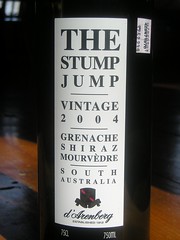 leathery, tobacco notes and exceptional length. A neat little twist were the rosemary, red peppercorn and mushroom notes on the finish.
Fireplace Wine
Grenache, Shiraz, Mourvèdre 2004, Stump Jump, South Australia, D’Arenberg ($17…ip..buy it)
I was surprised at its unoakiness. While a little too ripe for my tastes, and lacking the earthy, brett-infused flavours that I oh so love from my fave Rhônes, it drank well on its own. Layers of blackberry, cassis and other dark fruits were intertwined with a hint of pepper and cocoa on the finish. Super pleasant.
And The Search for the Perfect Pasta
I must admit to being completely surprised last night when I realized that today was the due date for the latest installment of Lenn’s Wineblog Wednesday. Being completely unprepared, and with super chef Nancy coming over for a fresh pasta lesson, I rummaged through the cellar looking for a bottle of Rhone. Aside from some pretty racy 1999 Vieux Telegraph which I was sure would have been way too powerful with our unplanned meal (the equivalent of shooting my cat with an elephant gun), the cellar was Rhone-less.
But I did come across two Australian bottles which were Rhône varietals, both from the house of D’Arenberg so I hope that it counts. So here are the reviews against the backdrop of a pretty successful pasta meal. Thanks for doing the hostin’ Jathan.
The Kneading Wine
Rousanne
e 2004, The Money Spider, McLaren Vale, D’Arenberg ($23…ip...buy it)This was my first taste of Rousanne outside of the Rhône and was quite surprised. It is named after an infestation of the Money Spider (Erigoninae for you Arachnologists out there) which ruined their first supposed vintage in 2000. Local folklore claims that kindness to these bugs brings both happiness and good fortune so the good folks at D’Arenberg decided to let the spiders have their run at the Rousanne and waited an extra year before making their first vintage. 3 years later I don’t know whether or not they are rolling in cash but the wine is quite good. Typical of the cépage, it had wonderful heady aromas of honeysuckle, chamomile with almost caramel overtures. It drank much richer than I had expected, lacking the acidity one normally associates with Roussane and had a hint of sweetness on the finish. All in all, pretty good.
The Pasta Wine
Morellino-di-Scansano 1999, Doc, Riserva, Moris Farms ($41…saq)
I had planned to follow with the D’Aremberg red but it didn’t have the earthiness needed for the mushroom filling of our Agnolotti. So I brought out the Italian to accompany our dumbo sized orecchiette with red pepper and rapini and the mushroom stuffed agnolotti. This lesser-known Tuscan winemaking region denotes itself with its use of Syrah alongside Sangiovese and Cabernet. With 90% Sangiovese, it reminded me more of a ripe Vino Nobile than Chianti, with ripe cherries and plums dominating the more typical
leathery, tobacco notes and exceptional length. A neat little twist were the rosemary, red peppercorn and mushroom notes on the finish.Fireplace Wine
Grenache, Shiraz, Mourvèdre 2004, Stump Jump, South Australia, D’Arenberg ($17…ip..buy it)
I was surprised at its unoakiness. While a little too ripe for my tastes, and lacking the earthy, brett-infused flavours that I oh so love from my fave Rhônes, it drank well on its own. Layers of blackberry, cassis and other dark fruits were intertwined with a hint of pepper and cocoa on the finish. Super pleasant.
Tuesday, March 07, 2006

The Pain and Pleasure of Drinking Jura
There are certain wines which require a certain reflection before casting judgement. Many of these wines have been around for hundreds or thousands of years, and have remained true to their roots, oblivious to the whims and scruples of changing tastes. I am speaking of the resin-infused Retsinas, the aromatically-challenged Bandols, the oxidized Grenache Blanc and Terret Blanc whites of the southwest, the Coulée de Serrant of Savennières and perhaps at the head of the pack, the Savignan based wines of the Jura. At first, these wines are not easy to drink, often needing an appropriate food accompaniment and an open mind. However, despite its Christmas tree sap overtones, to this day I have yet to find a wine that so well compliments that scrumptious Grecian mix of garlic, yoghurt and oregano as a good Retsina.
So in deference to those who have remained unique in the face of the homogenization that is much of the world of modern wine, here are a couple of wines to discover, understand and appreciate.
Arbois 2000, Béthanie, Fruitière Vinicole d’Arbois (saq..$23)
It is hard to think of the Jura without a mention of Vin Jaune, or ‘yellow wine.’ Made in its entirety with the local Savignan grape (a distant relative of the Traminer family), it is aged in old 60 gallon open casks in similar fashion to that of fino sherries, allowing a film forming yeast to develop on the surface. And there it rests for 6 years and 3 months until bottling. The result is a wine with a phenomenal richness, nuttiness and spiciness that accompanies a variety of strong cheeses and the classic vin jaune chicken.
A good way to enter the world of the Savignan is with this Arbois. Composed of 60% Savignan (aged for 3 years under the film) and 40% Chardonnay, it has the distinctive nuttiness of the vin jaune but with a touch of browning apples, lemon and vanilla. Serve it at 15 degrees Celsius (around 60F) so as to bring out as much of the richness, spice and nuts that it has to offer. Any cooler, and the oxidized flavors are too strong and the wines becomes way too acidic. It will work with wonders with terrines, chicken and in particular with a strong, ripe cheese like Raclette. We serve it at L’eau with a fondue of Victor and Berthold Reserve, laced with cumin and nut bread as the dipper, a phenomenal mix and one which very few wines could handle. My first bottle took me a week to drink but I am now a fanatic, so take your time, open your mind and mouth, and discover an extraordinary style of winemaking.
Chardonnay 2000, Les Bruyeres, Tissot ($28…saq)
Aged in barrels that once held vin jaune, this 100% Chardonnay is a touch more user friendly than a classic Arbois but New World butter fiend beware, this wine has torque! At 6 years of age, the majority of its fruit has dissipated into a rich, buttery nuttiness. Neither bitter nor smokey, it reminded me of hazelnut with floral overtones. Incredible with Guinea Hen or other stronger bird.
Macvin de Jura , Tissot
I don’t know if it qualifies as "wine" but it is made of grapes. The juice and must of Savignan grapes are reduced by half by boiling, and the resulting liquid is then fortified with brandy. Once this magic elixir reaches 16% alcohol by volume it is placed in oak casks to age for six years. There is no fermentation process. The result is an incredibly rich and unctuous fortified wine with a heavy amber color and aromas and flavors of nuts, citrus zest, prunes and other dried fruits.
Friday, March 03, 2006
 4for4
4for4+1 To Knock You Off Your Feet
Aside from the pure fun of getting blasted, last night’s wines followed a wonderful progression.
Before dinner
(music by Victoria Williams-Loose and John Hammond's Ode to Waits...Wicked Grin)
Riesling Spätlese 2001, Bernkasteler Badstube, MSR, Thanisch ($30…saq)
Hailing from the central portion of the Mosel region, I was shocked at how subtle the Thanisch was compared to Prum’s spatlese. It was as if the delicate pink grapefruit and apricot flavours had yet to be fully ingested by the typical Mosel minerality. But the balance between the sugar and acidity was perfect.
Vin de Pays des Côtes de Gascogne 2002, Cuvée Bois, Dom. Du Tariquet
From the heart of France's Armagnac region, this mix of Gros Manseng, Chardonnay, Sauvignon and Semillon was the surprise of the evening. Typical of the region's whites, there were peach, apricot and other exotic aromas supported by a nice balanced acidity. Atypical were the six months of new wood which added vanilla overtones which helped create a nice contrast with the minerality of the Riesling.
Lasagna Time
(music by Lee Morgan's Search for a New Land and Grant Green's Latin Bit)
Toscana Igt 2000, Le Volte, Ornellaia (2003...$29...saq)
Classic Toscan Igt mix of Sangiovese, Cabernet and Merlot aged to perfection like a 45 day old carcass. Over the last 3 years, it has lost just enough acidity to the benefit of a touch chewier texture which works so well with the leathery flavors of the Sangiovese. An elegant plumminess reminiscent of Venetia Merlot added a little seductiveness.

Connawarra 2001, Cabernet-Merlot, Petaluma
A very classy unfiltered Aussie Bordeaux assemblage aged for 20 months in French oak. Plenty of cassis and cocoa were supported by a hint of peppermint which kept it fresh. As this was the bridge wine between the main and the dessert, it was drunk on its own without any food.

Le Pudding Chômeur ..Martin Picard’s recipe in March Gourmet
(music Ben Kweller's On my Way and Jeff Buckley's Grace)
Spirale 1999, André and Mireille Tissot (2001...$60...saq)
Wow, if this is not one of the world’s great sweets than I don’t know what is. The Poulsard (red) and Savignan (white) grapes are picked at optimal maturity, dried on straw mats for 5 months, and then fermented with indigenous yeasts for over a year. The yeasts puttered out at 9% leaving a phenomenal 365 grams of residual sugar. The result is a dense and unctuous wine with an aromatic complexity that blew us away. A mix of straw, wild rose, apple, cherry and strawberry with a touch of honeyed maple gave way to apricot and spice. The mix with the pudding was sublime.
Wednesday, March 01, 2006
 An Aged Greco With That?
I know that we live in a cash and carry world. We have come to expect all that we want and when we want it. In an attempt to satiate our communal yearning for immediate gratification, the wine industry has shifted to more ‘from the barrel approach,’ using over-ripe grapes and other vinification techniques to speed up maturation. Fine. Maybe they will think of something to speed up the ‘diaper’ time of babies (perhaps hypnosis).
But to the patient goes the prize. I have often trumpeted the fun and payoff of cellaring a few bottles. As they age, youthful vigour is often replaced with aromatic depth and a mellowed complexity. It is the best way to get to know a wine. I have been sitting on this bottle for a couple of years now, waiting for the right moment when upon picking it up from beneath a clutter of half dusty bottles, it felt like its time.
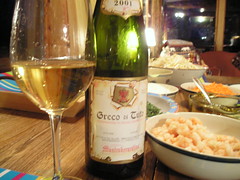
Greco di Tufo 2001, Mastroberardino ($24…saq..2003 now available)
One of the more ancient grapes of the Avellino region of Campania, the Greco was originally planted by the Greeks on the slopes of Mt. Vesuvius. Greco is by nature a grape which produces a relatively full bodied white, slightly floral with hints of grilled almonds. The last time I drank this bottle (2003), I had found the acidity took away from the finish. But two years later the story is much different.
What was a light straw color was replaced by a brilliant sunshine, tinged with gold. Slightly oxidative notes had replaced some of the acidity which worked much nicer with the long, slightly bitter almond and apricot stone finish. Its richness was on the level of a good Macon, but much more complex aromatically and with a good deal more happening in the mouth. It would be perfect with any grilled fish or perhaps a seafood fettucine dosed with some stronger Italian cheese.
Subscribe to:
Posts (Atom)