Wednesday, October 25, 2006


What Was Said....

'...intelligent...'
-Wall Street Journal Oct 23, 2006

'... holistic...'
-Wall Street Journal Oct 23, 2006

'.... practical...'
-Wall Street Journal Oct 23, 2006

'... better than CATS!'
-somebody else

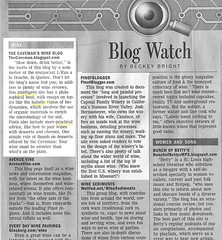
So how cool is that? Monday's Wall Street Journal mentioned my little blog alongside Pinotblogger, Avenuevine, Wine Sediments , Everyday Wine Pairings, and Mag's little irreverent ode to boisson, Wine Offensive. With this benediction brought thousands of new visitors and hundreds of new subscribers. So to all of you who are new readers, welcome!

Of course this means that I now have full licence, and perhaps even an obligation, to rework some favorite posts of the past year (yes, I am slack but what do you expect for free!). So , in honor of the WSJ, here is one of my faves...enjoy and welcome aboard.

Stop Drinking (bad) Corporate Wine!

Tom pointed to an ‘interesting’ article written by Jennifer Rosen defending ‘corporate’ wine. Defending it against whom I am not sure but the crux of her argument posits that this inexpensive ‘corporate’ wine, which is as familiar and as regular in quality as toothpaste, brings more drinkers into the marketplace. In the same breath, she seems to characterize those drinkers who expect more from their wines as neophytes and epiphany seekers, while the ‘clueless masses’ seem to want some sort of ‘bland’ drink that is as ‘reliable and cheap’ as Coke (quality notwithstanding). To paraphrase a paraphrasing blog buddy, her logic seems to suggest that to make wine accessible we must have more shit wine available.

Oh those poor, stupid, taste-deficient masses.

Well, wine is not coke. Unfortunately, there seems to be some underlying sentiment amongst certain in the industry to treat it as such; just another spoke in the wheel of the beverage industry. Perhaps I am being nostalgic and sentimental, but I still want my wine to be made by someone who grew and pressed his own grapes, and whose wine ultimately carries his signature and some sense of place. It might be quaint but there is more often than not a measure of authenticity about the final product that differentiates it from the yellow tails, little penguins, and other mass-produced, ‘brand’-oriented wines that fill supermarket shelves. Rosen makes the point that many of these more ‘artisanal wines’ are ‘perfectly dreadful,’ I agree, some of them are. But on the whole I find most of these wines more interesting, and at least not disgusting.

I have tried these price-point wines on a number of occasions. I am usually unimpressed, sometimes horrified and rarely surprised. My most recent foray into what Ms. Rosen refers to as ‘corporate wines’ was a tasting of Southcorp (Foster’s) ‘Little Penguin.’ The Chardonnay reminded me more of coconut tanning lotion than white wine, and the Shiraz was closer to Robitussin (without that excellent muted buzz). But this is a question of personal taste. I neither buy nor drink these penguin wines, as I won’t most of the cheap wines presently on the market. This is not because they are made by some massive, unfeeling corporate monolith, it is simply because they taste bad.

But, as children who were raised to believe that garlic-flavored popsicles are good, Rosen claims her ‘blandies’ expect nothing more than the ‘Tzatziki pop’ of wine and are thus happy and comfortable in their ignorance. This is bullshit. It is rare that I have not been able to take a person who has drunk only cheap wine and showed them that, for a few dollars more, there is a better option. And the majority of the time, they can taste the difference. Ultimately it is a question of priorities. It isn't that different from spending that extra 20% on organic produce, for it too is often better than the cheaper industrial produce which fills the aisles of your local supermarket.

It just so happens that these super-cheap wines, which are made affordable because of the economy of scale, are often below the threshold of what smaller wineries can afford to produce. I will not even get into how they are made. But for a few dollars more (at least here in Quebec), there exist a plethora of interesting wines from the world over, many made by co-operatives and good, independent winemakers. By supporting these smaller producers, we are supporting diversity, independence, and frankly they need the cash more than the big corps.

The reality of the modern wine industry is that there are fewer and fewer independent winemakers. Cheval Blanc, Etude, Ornellaia, Yquem, Penfolds, Coldstream and a vast majority of the better wine producers worldwide are now part of corporate portfolios. Like in any industry, there are good corps and bad ones. Those which recognize and continue to support the ‘artistry’ of winemaking and have not become complacent with quality deserve our continued support. Ms. Rosen’s characterization of corporate wine as cheap wine is an insult to many of the better corporations which continue to produce great wines. Her article should have been entitled ‘in defense of cheap, mass-produced wine,’ but even then, I don’t agree.The real danger of the big corps with large alchohol and wine portfolios lies more in the distribution end of the industry. It is here where smaller producers and distributors face increasingly difficult challenges and it is here that they need our support. So get off the kangaroo, seek out the independents and ultimately tell your friends to spend a bit more for their bottles, you will be doing both the industry, and your friends, a lot of good.

Monday, October 23, 2006


The Sommelier Experience

Ordering a bottle of wine in a restaurant can be an intimidating task. The food is ordered, and all eyes shift to you as you leaf from page to page in what you see as an unnecessarily long wine list, quietly hoping to come across a bottle that you recognize. Where’s that Brouilly or Yellow Label when you need it? As befuddlement becomes desperation, the sommelier arrives.

As a sommelier, my job is to demystify wine. In the few minutes that I spend at your table, I have to assess what style of wines you like, what you are willing to pay, and walk that fine line between what you want and what I feel you need. With a point of my finger and a nod, I can make you a hero with the right choice, or I can be your scapegoat if everyone hates it.

But who are these people, why should they be trusted?

The Dinner Table Maestros

I admit to having forgotten the year that my daughter was born, though I remember wines that I drank 10 years ago, with whom, at what temperature, and with what. I am the Rain Man of the food and beverage world. While the majority of sommeliers have arrived at their present occupations via some sort of wine schooling, I have never taken a course on wine. My education was in the kitchen, the tasting room and at the table. It is this equal reverence for both food and wine that separates the wine connoisseur from the best sommeliers. We don’t make either, but we have to understand both. In this sense we are like maestros, trying to create harmonies between what the chefs create and the wines we have at our disposal.

Spit or Swallow?

But we are first and foremost experts on wine. To that end, when I am not working the floor, placing orders, hucking cases, taking inventory and updating my wine list, I am tasting wines. This is the most romanticized aspect of the job, but as much as I try (often in vain) to get some sympathy, the reality is that it is still work. If I taste thousands of wines every year, there are only a few hundred that I actually order. The number of times I have had to smile with red tainted teeth, my mouth as dry as the Sahara, and find something nice to say about yet another wine that I know I will never order.

And to answer that most asked question, most of the wine I am served ends up in the spittoon, except for the really good ones where I sometimes go back for seconds.

The Language of Wine

While we sommeliers know a lot about wine, we do tend to speak our own particular dialect. The language of wine aims to find a way to compare one wine with another. It uses flavours, smells, textures and colors that we find in our glass to references found in our day to day lives. But these associations often don’t resonate with the majority of people who can’t find the ‘dark cherries, summer truffle nor the leather’ that we so cleverly found with a snort and quick swirl of our tasting glass.

Most people have a hard time communicating what they like in wines. The best way of letting me know is by remembering the names of some of your favorite bottles that you drink at home, but most people don’t and end up citing ‘Château … something.’ That must be the best selling bottle worldwide.

In an effort to bridge the communication gap and reach out beyond these staid and conservative descriptions, I have been known to compare certain Californian wines, for example, with the stereotypical beach bimbo (or the male ‘mimbo’ version); easy to like, the first glass is great but lacks the depth to be interesting in the long run. It is remarkable how many clients know exactly what I am talking about.

The ABW and the Curse of the Blue Nun

So now that we know where each other is coming from, it’s time to make our choice. The first thing I must establish is if you are part of the ABW (Anything But White). As a devoted white wine drinker, I am constantly amazed by people’s reticence to quaff a bottle of white.

It’s not your fault. I blame it on Blue Nun and other cheap white wines. If cheap red can be a heady proposition, inexpensive white can be near fatal. We have all had misadventures resulting from drinking one glass too many of some dubious white. It can be a Sisyphean task to battle against such distasteful memories, especially when one considers that the majority of foods work better with white.

Aside from finding the perfect Australian red for your lobster, there is one other thing that I can’t do. I don’t set the policy on pricing and while I understand your frustration that the bottle you want is two and a half times the SAQ price, as much as I would like to, I am not here to negotiate.

Getting the Most out of Your Sommelier

Here’s a hint, when a sommelier says that you should drink what you like, what he or she is really saying is that the wine that you want doesn’t go at all with your choice of menu. I am always amazed how people will give ‘carte blanche’ to the chef to create their dishes as they see fit yet can be relatively narrow minded in their choice of wines. So if you are lucky enough to have a sommelier at your restaurant, come with a sense of discovery, get out of your comfort zone and try something new.

I fear no client more than the wine collector who loves to list every wine he has drunk or the entire contents of his cellar. Nobody likes a snob and we sommeliers are a difficult lot to impress. Wine and the way it works with food can be fascinating, but it must be put into context. I see wine as a spice, a luxurious accessory to complement our meal. But in the grand scheme of things, that we can spend a couple of hours worrying over such ephemeral pleasures should remind us about what is really important.

That we are indeed very fortunate people.

Saturday, October 14, 2006

Look What’s Growing in Our Own Backyard

Modern winemaking in Europe dates back hundreds of years. California and Ontario’s first vines were planted in the late 19th Century. Here in Québec, our viticultural history takes us back only to the early 1980’s. With age comes experience, each generation passing down to the next not only more mature vines, but of even greater importance, the know how which only comes from the trial and error of experimentation.

As a wine buyer, my job is to be a ruthless critic. With so many wines on the market it is easy to be swayed by prejudice, damning an entire group of wines due to a couple of bad experiences and never returning. I admit to having relegated Québec’s wine industry to that scrapheap of mediocrity. I was wrong and am here to make amends.

At the root of this bias are the grapes themselves. Grapes like chardonnay, shiraz and cabernet sauvignon are of European decent, varietals of the Vitis Vinifera family. Our harsh winters and relatively short growing season once limited our options to the hardier, though often less interesting hybrids. But things are changing. Global warming has proven to be a blessing for Quebec winemakers as the extended growing season and milder winters have allowed for not only riper hybrid grapes, but an opportunity to grow chardonnay and other classic Vinifera species.

I recently toured a number of wineries in the Eastern Townships and was shocked by not only the quality and diversity of the wines being made, but by the passion and dedication of a number of our winemakers. Here are the stories of four of the best.

The Pioneer- Charles-Henri de Coussergues and Orpailleur
1086 Route 202, Dunham www.orpailleur.ca/

Québec’s first and best known winery, Orpailleur represents the old guard of Quebecois winemaking. When one talks with other winemakers, there is nothing but respect for what de Coussergues has accomplished. While he sees an opportunity in planting vinifera grapes like chardonnay, he continues to concentrate on the tried and true, with large plantings of hybrid white grapes seyval and vidal, seyval noir and marechal forch in red. The wines are also classic interpretations of the varietals; crisp whites and red berry laden reds and rosés. Of exception is his La Part des Anges, a fortified wine which was inspired by the wines of Maury in France’s southwest (see tasting notes at end of article).

Aside from running his vineyard, he is working to create a regulatory body similar to VQA (Vintners Quality Alliance) which presently overseees the wines of Ontario and British Columbia. The VQA works as a regulatory body whose aim is to create standards of quality, auditing winemakers to assure that what is written on the label matches what is in the bottle. An auditing system such as this would assure, for example, that the grapes did indeed come from Quebec and were not brought in from outside the province.


The Ice Master – Jean Joly at Le Marathonien
318 Route 202, Havelock www.marathonien.qc.ca/

Gold medals and awards are nothing new for Le marathonien. Most recently, Le Marathonien was the highest scoring ice wine at the prestigious 2006 Okanagen icewine festival in British Columbia, besting even the fabled icewines from the Niagara.

To make icewine, a winemaker needs an extended period of minus12C temperatures. While the milder winters of the last couple of years are causing headaches for many of Ontario’s icewine producers, the combination of riper grapes and our province’s frigid winters are ideal for the production of icewine. At least in the short term, this just might be the style of wine which might win worldwide recognition for our wine industry.

Le Marathonien is a converted apple orchard. Joly’s vines are planted in the gravel and rock that 12000 years ago was a part of lake Champlain. His approach to winemaking is rigorous, scientific and patient. While many of his colleagues are experimenting with different grape varietals and vinification techniques, Joly, like de Coussergues, is sticking with what has proven to work

Joly produces classic dry whites and reds, including a superb off-dry white made with a riesling hybrid called geisenheim. But Marathonien is all about sweet wines. And if Icewine is a bit rich for your palette, Joly is one of the few Quebecers to produce a Late-Harvest wine, which is in fact a second press on his icewine grapes.


The Cradle of Invention– Mike and Veronique at Les Pervenches
150 Boulais Road, Farnham www.lespervenches.com/


‘Who says Vinifera doesn’t grow in Québec,’ beams Mike Marler with as he rips away some leaves, revealing a beautiful cluster of chardonnay. Talk with Mike about his grapes, or how the various soil substructures found in his vineyard can produce subtle differences in aromas and flavours, and one gets a deeper understanding of the relationship a winemaker has with his vines.

The biggest impediment to growing many Vinifera grapes in Quebec is not the length of the growing season but the damage caused by our cold winters. Many point to Mike’s work with testing different materials and methods of winter protection as advancing the possibility of chardonnay in Quebec, and as proven by his medals and other accolades, this possibility has become reality. He is also presently in pre-certification with Ecocert, an international organic accreditation body, which will make Les Pervenches one of the few certified organic vineyards in Québec.

His wines mirror his experimental approach, and as we tasted barrel samples from last years harvest, one gets the sense each blending season is all about possibility and experimentation, not following a recipe. He is presently testing which grapes work best with American and French oak barrels, how the seyval grape reacts to different yields, and trying unique blends like in his award winning chardonnay-seyval, and one of my favorites, a light red blend of hybrid grapes frontenac and de chaunac with chardonnay.

A True Modern Winery - Léon Courville and Domaine Les Brome
285 Brome Rd, Lac Brome http://www.lespervenches.com/

Ex-President of the Banque Nationale, Léon Courville began planting his vineyard in 1999. Domaine Les Brôme is a well financed, modern winery and is on the cutting edge of Québecois viticulture. With over 40 000 vines planted which include proven hybrid grapes as well as chardonnay, pinot noir and reisling, Courville seems to be well en route to proving that Québec can produce high quality wine which can compete on an international level.

As one of the big winner’s at the recent Coupe de Nations de Quebec, which recognizes excellence in both local and international winemaking, I came to Les Brome intrigued and left astounded. Courville is so confident about his wines that he was not simply content to just have me taste his wines, he wanted me to compare them with classic French bottlings which were at times more than twice the price.

First up was an off-dry vidal, a grape which is almost always reserved for making sweet wines. I tasted it next to a pinot gris from Alsace and the similarities were remarkable. His cuvee Charlotte, a blend of seyval, geisenheim and chardonnay held it’s own against, and I am not kidding, a Meursault.

For those who doubt that Quebec can produce high quality, elegant red wine has not tasted the de chaunac reserve. With help from Madiran winemaker Alain Brumont, Courville has perhaps found a home for this French hybrid, a grape that was developed in the 19th Century. Still in barrel, I tasted both the 2004 and 2005 cuvées which were overflowing with sweet field berries, a touch of licorice and mineral notes, all supported by a delicate tannic structure.

The Problem

Never heard of these wineries? Don’t feel bad because neither have most Quebeckers. Small-scale winemaking is a costly proposition anywhere, and because of the extra work required to ‘winterize’ our vines, even more costly here in Québec. Unfortunately, the SAQ has done little to help our industry by employing the same purchase policy they use on wines imported from outside of Québec, nor offering preferential displays in the stores. This means that Quebec wineries must sell their wines at uncompetitive prices at the SAQ or lose thousands of dollars of much needed revenues. With no shop window except for at the winery, the majority of consumers don’t have access to these wines, thus hindering sales and ultimately the evolution of the industry here in Québec. It’s a case where everyone loses.


Tasting Some of Quebec’s Best

Seyval 2005, Orpailleur ($12) Reminiscent of a Muscadet, this is a classic interpretation of the varietal, combining mineral notes with a bright acidity and citrus flavors. It would work wonders with oysters, mussels, a light fish or a fresh goat cheese.

Rosé 2005, Orpailleur ($13) combines classic red berries with a hint of spiciness alongside a well-balanced acidity. Soft and delicate, it is a perfect apertitif wine or to accompany a light lunch.

La Part des Anges, Orpailleur ($13..200ml). My favorite from Orpailleur, this blend of unfermented seyval juice with Brandy is left in open casks for 6 years endures a cycle of baking in the sun and then sub zero winter temperatures. The result is a reminiscent of a sweet sherry with a sensual mix of hazelnut, fig, and caramel. Try it with a crème caramel or with a selection of stronger cheeses.

Cuvée Speciale, Marathonien ($11), an excellent white, off-dry blend of Geisenheim, Seyval and Cayuga. Aromatic like a Muscat, the touch of residual sweetness balances the acidity to make an excellent ‘vin de soif,’ perfect for a hot afternoon or any meal with exotic spices.

Vidal Icewine 2003, Marathonien ($50 for 375ml) His icewine undergoes a long, slow fermentation and is only bottled when Joly feels it is ready. Each sip of is a decadent explosion of apricot, peach, and apple smothered in honey. With a fois gras, it makes a wonderful home grown alternative to Sauterne.

Seyval-Vidal 2004, Les Pervenches ($14) A touch richer and with less acidity than the Seyval of Orpailleur, this oak aged Seyval would be perfect for a light fish or a cheese fondue. It should have even more body in the 2005 version as it will be blended with Chardonnay rather than Vidal.

Chardonnay-Seyval 2004, Les Pervenches ($20) A Macon style Chardonnay that combines nice mineral notes with apples and peaches, all backed with soft, unobtrusive oak. It would work well with any seafood, especially when served in a cream sauce.

Solinou 2005, Les Pervenches ($14), a bright and refreshing red that exudes fresh summer berries. Composed of frontenac, de chaunac, with a touch of chardonnay, serve it chilled as an aperitif, with cheese and pâtés or with a spicy vegetarian dish.

Vidal 2003, Domaine les Brome ($15) Floral and mineral notes, a hint of residual sugar and a rich, and delicate texture make it a perfect match for a nice spicy seafood dish, I kept thinking shrimps with a green curry sauce.

St-Pépin Reserve ($19) is an extremely elegant white that combines delicate floral and exotic fruit aromas with an almost Burgundy type richness that comes from being ermented and aged in new French oak barrels. It would be great with a seafood risotto.
Friday, September 01, 2006

Aged Rosé and the Winner Was......

Greek….....huh? In fact, my favorite rosé of the summer was curiously my preferred pink from last summer; same wine, same millisème, except one year later (the saq did not order the wine for this summer).

I am a firm believer in the short term cellaring of wines… all wines. I have found that even the most banal of bottlings benefits from as little as 6 months in a cool, stable environment. The rule is never drink from the store, aim to stock the basement and use that as your inspiration for the evenings dinner. Aside from the pleasure of slowly watching your collection grow and seeing what styles of wines you need, your wines will simply taste better.

Agioritikos Rosé 2003, Tsantalis ($16…saq)
From the slopes of Mount Athos, this mix of Limnio, Roditis and Xinomavro is packed full of wild strawberries and raspberry. While last summer it’s bright acidity made it a perfect aperitif, a year later it drinks more like a soft red. It is still the same wine, though the ensemble seems more integrated, with less acidity giving way to a richer, more opulent texture. We drank what was left in the province (13 bottles) mostly with salmon, mostly in the sunshine, and always around half way through the bottle we would take a moment to give the wine a good swirl, take a sniff and a sip and remark, ‘c’est pas mal bon cette petit rosé.’

What more needs to be said about a wine.

Wednesday, August 23, 2006


10 out of 10 Worms Agree!

I went into this summer with the best intentions but between battling groundhogs in the garden, 4 jobs and a new gig wine writing for the Montreal Gazette, little time was left for this little labour of love.

So I will start slow and in fact allow someone else to fill the content. The following is one of 24 comments I have recieved on a post about bio-dynamics. I strongly urge you to go back to the original post and follow the thread as it shows how controversial and emotionally charged this issue has become (especially when one considers how many new converts there are to bio-dynamics).

So take it away 'Dave.'

Woooo, I'm a bit late to the table here, but can't resist the temptation to comment. I'm a new user, call me Dave. I have several areas to comment on, let's start with the 6 year study that showed no differences between BD (bio-D) and organic. There were indeed no statistically significant differences in nutrient content, physical characteristics or biological life/processes in the soil between the organic and BD. What doesn't show up in that quote, a single year composting trial did result in statistically different, 30% better nutrient retention in the compost which was made using BD preparations over the compost made from the exact same starting material that did not have the preparations added. I echo some of the other posters skepticism regarding the preparations, yet I do farm biodynamically, and this result astonished me.

Continuing, an unpublished experiment by Reganold's research team was rather unconventional. A rectangular box was constructed. One side of the box contained soil removed from the BD section of the vineyard in the 6 year study, the other half contained soil from the organic section of the vineyard. Worms were collected from the entire vineyard, both organic and BD areas, and then the worms were placed in the box in between the two different soils. The next day the researchers came back and noted that all of the worms had moved into the BD soil. There were no worms in the organic soil. The point? Though modern scientific techniques could find no significant differences in the soils, a bunch of "lower" life forms were unanimous in their selection; we cannot, with current technologies, always find the answers.

Further, to the point of what is the difference between organic and biodynamic. If you are a VERY good organic farmer, there is very little difference, just the preparations, the calendar (these two being the rituals?), and an emphasis on limited inputs. However, you can be organic these days and still farm with the mindset of a conventional grower, i.e. instead of creating a diverse farming agroecosystem that mimics nature (good organic), what organic pesticide can I spray that will kill my pest organism (bad organic)? Organic pesticides are getting better and better my friends, to the point that the farming style can be very similar to a conventional grower. Thus, being BD automatically puts you on the extreme "good organic" side of the spectrum. People generally associate BD with the preparations and all of the wackyness that entails; however, it is based on very good farming technique. We like to say that the preparations are the icing on the cake; should you not have good farming practices in place, your cake will still be worthless even though you've got great frosting.

So, Mithrandir et al., don't get all bent over the preparations, yes they are weird, but they are a small part of the final product. I was offended by Mithrandir's supposition that science is the end all beat all authority. I have worked as a researcher in universities; never forget that most of your science is paid for with grants from large companies to either get a profitable product, or test a potential profitable product. Mysticism? Try looking at it from another viewpoint, try looking at it as farming techniques that work, passed from generation to generation. Why plant on a particular lunar phase? Has it been proven to work at a university? Perhaps it has been studied, I did not check. But usually, if there is no profitable product at stake, thus no scientific inquiry. Reganold was questioned by many of his peers regarding that 6 year study in the vineyard, they basically thought he had committed professional suicide. Believe me, I'm not saying that this true for every, or even the majority of the BD practices (or reasons for scientific studies for that matter), but some BD practices that may be thought of as mysticism certainly fit here.

I am a BD Skeptic that practices BD viticulture. Very little of my farming is centered on the preparations. It is more about how I can grow a balanced vine with very limited inputs (which is a basic part of BD by the way, but not organic). Thus, the resultant fruit is of high quality and representative of the soil in which it is grown rather than the organic inputs (fertilizers, insecticides, fungicides) that I can use. THAT is what is most important about being BD to me.

Caveman, I'd love to hear what came of your investigations on that post about Randall Grahm...
(And I am still waiting too........................!..caveman)

Friday, June 23, 2006

Garden Rosé Tasting #6

Chino 2005, Cuvée Réné Couly, Couly-Dutheil (saq...$16.60)

Against the backdrop of creeping thyme in full flower, this lip gloss colored “rosé de saignée’ was a bit of a surprise. Composed of 100% Cabernet Franc, the first whiff announced a full-on fruit assault with the accent on fresh strawberries still with their green tops. The first sip confirmed an almost precocious adolescence, with a hint of sweetness on top of slight ‘perlance,’ fine little bubbles dancing playfully over your tongue. But with some time, this little Lolita shed some of her coyness, showing a more floral side, an elegant mix of poppy and lilac alongside an admirable depth. While I, like many, admire the fragile and enticing beauty that comes with youth, here is a case to wait and see what a little maturity will bring.

I am stocking a couple of bottles for next summer.

Next post...Vin Gris is dethroned!

2006 rosé ranking
1. Vin Gris de Cigare 2005, Bonny Doon
2. Toscana Igt 2005, Rosato, Carpineto
3. Chino 2005, Cuvée Réné Couly, Couly-Dutheil
4. Coteaux du Languedoc 2005, Château de Lancyre
5. Costières de Nîmes 2005, Domaine Saint-André
6. Saint Chinian 2005, Clos de L'Orb

Thursday, June 15, 2006

Wine Blog Wednesday #22
Light Alcohol Reds

Alcohol is up. Turely, Rolland, Parker and many other influence peddlers have without doubt left their mark, promulgating a super (over?) ripe style of wine. But don't shoot the messenger, rising alcohol levels are not their fault. When Tim at Winecast proposed the low alcohol reds theme, and setting the cut off at 12.5%, I was confident that I could rummage through my collection of organic Beaujolais and be faced with that beautiful dilemma of which one to choose.

Wrong. Metras, Thevenet, Foillard, Lapierre, names synonymous with the ‘vin nature’ organic movement in France all had abv levels ranging from 12.5% to 13.5%. Metras’ Fleurie 2002 had an alcohol level of 12%, coinciding with the one of the weakest years France has witnessed over the last decade. If any group of winemakers can be counted on to refute the ‘modern style’ it is these guys. However, as these winemakers strive for optimal ripeness, eschewing without any additives (even sulfur) or manipulations, the unprecedented higher than average summer temperatures that Europe has seen over the last 7 or 8 years has played an even bigger part in taking French wine towards high abv than a conscious decision to make a more ‘new world style.’ So what to drink below 12.5%

How about 5%?

Brigantino 2003, Casorzo Doc, Accornero ($23…ip)
Hailing from Piedmont, the Brigantino is made almost entirely from one of the innumerable Malvasia varieties scattered throughout Europe, Malvasia di Casorzo. Slightly frizzante, this is a very pretty wine that combines rose petals, wild strawberries with a hint of plum. It sweetness is balanced by a nice acidity and of course, the bubbles. While it drinks almost too easily as an aperitif, it is the perfect accompaniment for one of our favorite desserts, rhubarb and strawberry pudding.

Tuesday, June 13, 2006

Garden Rosé Tasting #5

Vin Gris de Cigare 2005, Bonny Doon (saq...$17)

With a label inspired by a local French law which forbade spaceships from landing in their vineyards (I’m serious), this is yet another Randall Graham homage to Châteauneuf-du-Pape. A blend of Grenache, Cinsault, Mourvedre, Cunoise, Syrah and Viogner, the 2005 version strikes me as his best effort yet.

The color is a delicate pink with orange highlights. The bouquet is both pretty and complex with a nice balance struck between typical Provençal herbs like rosemary and thyme, and a nicely understated fruit of guava, strawberry and pomegranate.

The mouth is bone dry with a nice crisp acidity and follows through on the herbal notes that we found in the nose, though with the addition of some red peppercorn. It had decent length and I found a hint of iodine along with a touch of strawberry on the finish.

Oh but what to eat? It works okay as an aperitif with all those herbal notes, but it's a shame not to give it some food. It would be a great lunch wine with a salad nicoise or even better, with a cold lobster salad served with some roquette and other bitter greens, or as we did, salmon.

This year, the SAQ tripled its order to 3000 cases to satisy what seems to be an insatiable local demand for this Randall Graham creation. And with reason, as it is consistently one of the better rosés on the market, and probably the most complete rosé I have tasted this summer….. so far!

Garden Update
Everything is in the ground or seeded, but as the azaleas bloom, one must pay homage ourselves. Next up…a rosé from Chinon.

2006 rosé ranking
1. Vin Gris de Cigare 2005, Bonny Doon
2. Toscana Igt 2005, Rosato, Carpineto
3. Coteaux du Languedoc 2005, Château de Lancyre
4. Costières de Nîmes 2005, Domaine Saint-André
5. Saint Chinian 2005, Clos de L'Orb

Monday, June 12, 2006


Biodynamic in Bordeaux
The Seemingly Ageless Château le Puy


While the debate over the merits of biodynamic agriculture continues, one cannot argue about the quality and uniqueness of many of the wines produced by those winemakers who follow this discipline. The wines of Leroy, Joly, Weinbach, Ostertag, Gauby, Lapierre, to name but a few, are some of the finest examples of their respective regions. The real question is whether the quality of these wines are a product of bio-d, or simply due to that unique combination of winemaker skill, attentiveness, soil and climate.

While biodynamics is gaining adherents the world over, staid and conservative Bordeaux has so far resisted the temptation to hang and bury plant-stuffed deer bladders. However, there is one winemaker who has taken that leap of faith, embracing not only bio-dynamics but also a more organic approach to vinification via the use of indigenous yeasts, little or no sulphur dioxides, no fining or filtration.

The witch in question is Jean-Pierre Amoreau of Château le Puy, a 25 hectare vineyard in the Côtes de Francs region of Bordeaux. It shares the same rocky plateau as Saint-Emilion and Pomerol, with his site sitting atop the ‘Côteau des Merveilles,’ a name which pays homage to the quality of the wines produced at a Château which has been in operation since 1610. His wines are dominated by very ripe merlot with small percentages of Cabernet Sauvignon and a touch of Carménère, and are marked by a bright acidity which offers an exemplary freshness and length.

Amoreau scoffs at his fellow countrymen who have succumbed to what he refers to as the whims of the export market and their critics. While he uses Michel Rolland’s laboratory for analysis, he refers to Rolland as a brilliant chemist, someone who understands marketing more than wine. He in unabashedly Bordelais, believing that while his wines should be approachable in the first few years in bottle, their destiny is to be passed on to later generations, a snapshot of the year they were made and of the person who made them.

Before I launch into a tasting that went as far back as 1955, it should be noted that these are $23 bottles, not the ‘mortgage your house and let the kids eat lentils’ first-classed growths. I was shocked at not only how the bottles showed the same exemplary lineage, but also at how they aged with such grace and elegance. Thanks to Erwan and the gang at AOC for arranging a great tasting and dinner.

Château le Puy 2001 (saq…$23)
Soft and delicate red fruits with a hint of truffle and held up by very ripe tannins. A great bottle from an underrated vintage.

Château le Puy 2000
I found the balance slightly off, with a tart black cherry aftertaste that cut into the expansiveness and creamy-mouth feel that was so sexy in the 2001.

Château le Puy 1989
A beautiful bouquet that combined dark plums with herbs. It had a similar touch of tart cherry as the 2000 but in this context, it added freshness that was a beautiful counterbalance to the darker, slightly jammy fruit.

Château le Puy 1970
Remember, this wine costs $25! This is how Bordeaux should be drunk. A generous bouquet that combined herbs, tobacco with a hint of leather was followed by a profound fruitiness that evoked the same bright plum and tart cherry of younger vintages but in a richer and more elegant framework.

Château le Puy 1967
The first to have signs of age, it still had that signature acidity but the fruit was a touch cooked (think of port). If you like the style, and lots do, then it was great. I dumped my glass and took a big boy gulp of the 1970.

Château le Puy 1955
It smelled and tasted younger than the ’67, except for hints of strawberry and red cherries that gave the wine a certain softness unfound in the other vintages. Very pretty and again, that brilliant acidity kept the ensemble fresh.

Château le Puy 2003, Cuvée Barthélemy (saq…$60)
With no added sulfur, the Barthélemy is one of the finer examples of wines made in this model. Not reductive in the least, it had a ton of fruit held up by soft, round tannins. It made me kinda think of a young Brigitte Bardot for some reason. Ready to drink and will be available at the SAQ in the coming months.

Château le Puy 2001, Cuvée Barthélemy
One of the problems with no sulfur wines is the risk of oxidation. While the ’03 was perfect, I found the 2001 slipped a bit into that porto fruit area. Very drinkable with notes of cassis and almost a Languedoc type garrigue bouquet.

Monday, June 05, 2006

A Monster in the Minervois

France's Languedoc-Roussillon is a vast and fertile region home to over 400,000 acres of vines. To put this into perspective, this is more acreage under vine than in all of Australia. As the majority of the annual production of 18 million hectolitres of wine is destined to be simple ‘vin de table,’ one could point an accusatory finger at this region for its continued role in adding to what is becoming a worldwide crisis of oversupply of low-quality grapes and wine. As the price of grapes continues to fall, those growers who don’t produce either high-quality grapes or their own wines are finding it difficult to make ends meet.

In what I see as a more productive reaction to the crisis than brandishing pitchforks and blockading highways, efforts are being undertaken on a number of fronts to deal with the oversupply. The cheap stuff is undergoing a cosmetic makeover with hipper packaging and marketing to counter the increasing dominance of Australia and California in the low-end price point. Vines are also being literally ripped out of the ground, making way for more viable cash crops.

Winemakers in the region have also made a conscious decision to produce better-quality wines. Didier Baral in Faugères, Ollivier Jullien in the Languedoc, Marjorie Gallet in the Roussillon are but a few of hundreds of excellent winemakers making reasonably-priced, high-quality and distinctive wines. While many of these winemakers are taking advantage of the region's penchant for experimentation by planting international varietals and using modern vinification techniques, the winemakers that I appreciate most are those who work with indigeneous red varietals like Grenache, Carignan, Syrah and Mourvedre, and white varietals like Roussane, Macabeo and Grenache Blanc and Gris. Here is one such wine.

Minervois La Liviniere 2001, Clos de L’Escandil, Giles Chabbert ($27..importation Privée)
This winemaker and his wine encapsulate perfectly what is happening in today’s Languedoc. Taking over from his father who sold his grapes to the local co-op, Mr. Chabbert now makes his own wine with one foot firmly planted in tradition and the other ‘toeing’ the sand of modern viticulture. A blend of Syrah, Vieilles Vignes Grenache and Carignan, the Clos was rich, ripe and juicy like an over-ripened dark plum. At 14.5% alchohol, hints of black pepper, cloves, black licorice and cooked fig harkened memories of zinfandel. Well-structured with decent tannins, it was a dream with our bbq baby back ribs.

Interesting Languedoc red wines available at the SAQ
Ch. Lancyre Pic St-Loup Grande Cuvée coteaux-du-languedoc 2001 ($24)
Château Puech-Haut Saint- Drézéry coteaux-du-languedoc 2001 ($36)
Domaine Clavel Les Garrigues coteaux-du-languedoc 2004 ($18)
Domaine Borie de Maurel Esprit d'Automne minervois 2005 ($16)
Château Coupes Roses Granaxa minervois 2003 ($22)
Château de Combebelle Comte Cathare st-chinian 2001 ($21)
Donnadieu Cuvée Mathieu et Marie st-chinian 2004 ($16)