Monday, February 27, 2006


Touch me Cinderella

Like father, like son, always there for a good story.

Touraine 2004, Cendrillon, Domaine de la Garrelière ($24...saq)

Like its namesake, this ‘cendrillon’ is as easy to drink as the fairy tale is to read. A unique mix of 85% Sauvignon with equal parts Chardonnay and Chenin, of which a part touches wood, this is a Bio-dynamically grown wine that is both pure and uncontrived. Floral notes of sweet lime and a hint of ripe apple and white pepper fill the glass, giving way to a magnificent mix of creamy citron zest and a touch of more typical Loire grass. It has a warm summer evening approachability to it, with just the right mix of acidity and mellowed richness.

It went down all too imperceptibly with a classic caveman family dinner item; broiled roulades of Atlantic salmon, served atop cucumber spaghettini, and a slightly curried tamari, lime ginger dipping sauce. Roasted asparagus and red peppers were on the side, seasoned with a touch of olive oil, lime and black pepper. And yes nancy, lots of rice too.

Wednesday, February 22, 2006


Bio-D for You and Me
(But maybe not for St-Vini)

"The religion of the future will be a cosmic religion. It should be based on a religious sense arising from the experience of all things, natural and spiritual, and a meaningful unity between the two.’

It is difficult to speak of biodynamics without waxing philosophic. While it parallels organic farming in it's use of organic materials for enriching the microbiology of the soil, it embraces a much more holistic vision that sees any farm as a single organism whose success or failure is dependant upon the health of the greater organism in it’s entirety. Unlike both chemical and organic agriculture, it is not solely based on the ‘soluable,’ the simple reduction of a plants needs to elemental additions of nutrients, but ties the plants health into a more unified ecological vision. It is concerned with the subtle manipulation of life forces (energies) and aims to work alongside these rhythms of nature.

In this metaphysical sense it shares much with Chinese medicinal practices, both homeopathy and acupuncture, which recognize these subtle energies (chi) within each of us. On a practical level it espouses many of the principles of perma-culture, reflecting the design and interactivity of self reliant and self contained communities.

It obviously an easy target to lampoon. It’s use of homeopathic doses of compost energizers made from plants fermented in animal bladders and bones is but one of the practices that test the left side of our brain. But acupuncture and other alternative medicines are gaining acceptance by the mainstream, even though there is little scientific evidence that it actually works, and this to the disdain of much of the medical and pharmaceutical community. On the other hand, the damage that pillars of modern agriculture such as chemical fertilizers and pesticides have done to the environment are well documented. The lesson here is that as a race we still have much to learn about the subtle interactions the exist in the natural world. Perhaps this is at the root of an emerging anti-science movement, embracinga new more holistic perspective. Perhaps it is just filling a void.

But while the jury is still out on wether or not it actually works, the list of winemakers espousing this approach is both impressive and growing (Bonny Doon in California, Huet in Vouvray, Romanée Conti in Burgundy and a 'who's who' list of the best winemakers in Alsace to name but a few). For the list to keep growing, there must be something to it aside from marketing potential.

Yesterday I sat down the André Ostertag, an Alsatian winemaker who has been practicing biodynamics for close to 15 years and I asked him what were the ‘observable’ benefits he could attribute to his practice of biodynamics. While he has a penchant for the poetic, he spoke of grapes achieving an earlier (8-10 days) maturity compared to his non bio-d neighbours. He spoke of the verticality that other bio-d winemakers like Pinguet from Huet have mentioned to me. This translated to thinner trunks, and leaves which mysteriously grew in a way which they would not shade one another. But in then end, he spoke of equilibrium and balance and his plants capacity to synthesize the micro elements necessary to healthy, productive growth. He was convinced.

I drink a lot of wine and many of the above bio-d producers are behind the wines that I love the most. Is it because of the mechanics of bio-d or simply because they are simply more attentive to their vines? For me what separates the great wine from the good is it’s ability to transport me, to make me feel awe. The need to spiritualize human life is part of what makes it interesting; a little vacation from the rational. So within this framework, I am willing to at least stay open to the idea that a vine could benefit from these subtle interventions, and that it will be it’s best when it’s health is considered in a cosmological perspective. As the continued refinement of this approach is based upon careful observation of the environment and communication between practicioners, this too might lead us to a more profound understanding of our environment (sometimes it is fun to go outside the box). And perhaps this is what Einstein was alluding to when he talked of the “unity between the natural and the spiritual.‘

Wednesday, February 15, 2006


Reviewing the Reviewer
My Problem with New World Pinot


Pinot Noir is a cépage which has a great affection for the coolest of micro climates. But of even greater importance, it loves a slow, righteous ride towards maturity. It is the key to maintaining its fragile acidity and ethereal aromas.

I like Pinot Noir and have a penchant for Burgundy. For me, a great Pinot shows a perfect balance between acidity and texture, fruit, earth and spice. It is a precarious balancing act, but when done right it can be the apogee of red wine drinking. It is soft, delicate, yet powerful. I imagine it is a question of a perfect maturity, as over-ripe Pinot for me harkens memories of Welch's more than wine.

The Pinot grape is now vinified throughout the world. And although great care has been taken to find the appropriate cooler climate zones, I find most of these ‘New World’ Pinots weighted too far towards the fruit end of the teeter-totter, and thus lose that burgundian boom, that so soft explosion of amplitude; too much power and concentration at the expense of elegance.

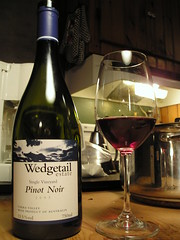
I recently drank a Wedgetail 2003, Single Estate, Yarra Valley Pinot Noir ($37…importation) and upon visiting his site couldn’t help but notice the care Guy Lamothe takes in putting together his wines. His wines are finely crafted, relying on hand-picked fruit (which I assume is to prevent over-ripeness), indigenous yeasts, french oak….all things which I look for in a wine and respect in a winemaker. The wine itself was loaded with black cherries, mocha and currents. It was ripe and round and had a certain length, however I found the fruit a bit stifling, impeding any sensation of true depth. This is a critique I could throw at any number of New World Pinots that I have tasted.

So, why didn’t I like it more? Why have I struggled all day over what was supposed to be a simple review of a dinner amongst friends. I guess I read the review of the wine and felt like I was not doing justice to Mr. Lamothe's effort. As one drinks more and more wines, one can sense when care and effort have been made in putting them together, as is the case with the Wedgetail and many of the Pinots that I don't drink. They are simply not for me, but I could see how people could love these wines.

As we are all reviewers and our opinions carry a certain weight with those who follow our blogs, we should be open to the prejudices that are behind our opinions. These are not always evident, but they can be fair if we are honest with our readership. Sometimes it just requires a little introspection, and perhaps a little delay before pressing the ‘publish’ button.

Photo par karl boulanger.. merci encore pour le cours

Thursday, February 09, 2006


Wine and Music
Waxing Poetic for a Change of Pace


Savigny-Les-Beaunes 1er Cru 1997, Les Serpentières, Maurice Ecard et fils ($57...importation)

Taking a gulp of Basic Juice has brought back a bit of perspective. Great wines achieve greatness for reasons which go beyond simply what is in the bottle. It is all about the pairing; with the food, with her skin, her eyes, with the mood or with the tunes. There is something inexplicably beautiful about this transcendance that reminds us that life is more than the routines we acquire, more than simply the explicable mechanics of it all.

Tonight it is cold, real cold. And with the wood stove cranked, and the house quiet, I am lucky enough to have chosen the right bottle for the circumstance. This is Burgundy, a wine that revels in it’s complexity, a wine that as the hours pass discards previous impressions, only to reveal new variations of the theme, gaining complexity with that ever elusive amplitude that only Pinot Noir can capture. If I put on Miles Davis’ Kind of Blue, the harmonies would be outrageous. It has been 6 hours since I opened the bottle and those low level tannins are still present, not at all inhibiting, acting more like a Bass, keeping beat, adding depth, maintaining the structure. Ecard works with fruit, and what started as notes of kirsch, red-berries, nutmeg and some sort of flower whose scent is just a bit beyond the grasp of my memory, has become cherries and raspberry jam mixed with a velvety earthiness. It is so soft, so delicate, so powerful. I smell my empty glass and it is still alive with flavour, almost a smoky strawberry jam. Burgundy rocks.

Monday, February 06, 2006

Superdrunk XL
Seven Guys, Lots of Meat, Sartre and the Cultural Divide

There are few places in North America where one can put 7 grown men together in front of the Super Bowl and of those 7, 2 need the rules explained to them. In fact, I was the only person in the room that had even played the game. There was little talk of strategy around this tv, these boys wanted to know more how the ‘mauradeur’ position translated into English (safety), and why in hockey the puck has to go completely over the line while in football it merely has to break the plane.

So as the game itself is often overshadowed by the ads (how about that Fed EX caveman ad), our drunken comraderie and lack of real interest in the game was soon overshadowed by some inspired conversation. Of note was a tirade by one of my more revolution-oriented friends about our new Prime Minister Harper’s acceptance speech whereby he ‘thanked God.’ “Just like Bush,’ he sneered. This might strike my American readership as a tempest in a teapot, seeing that for most American politicians and sports heros God seems clearly to have surpassed Mom as the ultimate guiding force behind any real success. But for us Canadians, at least for those of us in front of the tv last night, this brazen mixing of Church and State by our Prime Minister was both new and undesirable.

So as we tried to list what were the truly ‘secular’ states of the world, I was reminded of the roots of this secularism, and the harsh reality that is the void without divinity. Kafka often compared humanity to bugs. 'So what happens when you die,' was the question before the floor? Well I guess you are a dead bug. Hmmmm. Having just turned 40, I decided to put off dealing with this question for another ten years and returned to a spirited conversation as to wether the Cowboy cheerleaders were actually any better than the Raiderettes.

I guess the divide is at times not that wide after all.


Pregame….beer (DAB, Boréale and Grolsch)
1st quarter….. more beer
2nd quarter….. um, more beer
Half-time… wines served alongside choice bits of 5 different animals, tasting notes are approximatations and why do the Stones still insist on playing Start Me Up?

Faugères 2001, Cuvée Jades, Leon Baral ($30.. importation)
… Optimally ripe Syrah and Carignan, soft, well integrated tannins, loads of blackberry with some wonderful spice notes)… superb length

Mendoza, Malbec 2003, Reserve, Lurton ($18..saq)
… less concentrated than the Faugeres so took a sip or two to adjust, but very worthy for the price. Typical Malbec notes of black licorice with overtones of dark, ripe fruit.

Cahors 2001, Montplaisir ($13…saq)
…good if you like French style Malbec but not my cup of tea

Margaux 1986, 3ieme Cru Classé, Château Kirwan
...probably shouldn’t have been drinking this at this point of the evening but my host insisited on opening it. Still remarkably tannic, and was pretty undrinkable after leaving it alone for half an hour. It slowly opened up to show cooked fruit but little of those delicate floral aromas one so often gets with great margaux. Okay, but my sense was that it was a touch passé date.

Friday, February 03, 2006


Food Quandary #3
My Favorite Wine and a Quebecois Ham


Sometimes the answer is right in front of us, but for some reason we refuse to open our eyes. This is often due to the comfort of resorting to the tried and true, which is often a barrier to going outside of the box.

The Ham in question is a smoked shoulder, pricked with cloves and cooked in a mix of beer, onion and molasses. The meat is red and smoky, rich and fleshy with an obvious touch of sweetness. This would theoretically lend itself to a ripe new world red, however, the salt factor has always proved to be the bug in the system, turning the softest tannin into iodine. And the powerful flavors have always seemed a bit overbearing.

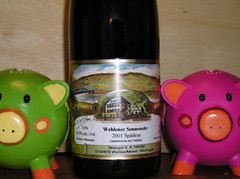
So for round 16 with my favorite Ham preparation I went white and German. The pairing was phenomenal. This classic, rich Mosel Spatlese had enough flesh for the richness of the ham, a plush creamy texture that was in no way out of step. The molasses was in perfect harmony with the residual sweetness of the wine and the undercurrent of spice was perfect accompaniment for the clove. The saltiness of ham brought out explosions of sweet grapefruit and apricot, and the phenomenal minerality and acidity kept the ensemble fresh. Simply put, the harmony was even better than the sum of the fantastic individual parts. When will the German’s ever let me down?

Wehlener Sonnenuhr, Riesling 2001, Spätlese, S.A. Prum ($30…saq)
Yeah Baby.

Wednesday, February 01, 2006

Whine, and Food (Blogs)

I did a little web cruising yesterday and came across Waiter Rant, a Gestalt type therapy site dedicated to those of us who peddle food and wine for a living. Everyone seems to have their bitch. While I pride myself in my ‘aggressively passive’ non- judgemental character, I too have a beef.

Dear Client,
You are not special because you drink wine. Nobody cares what you have drunk, how many vintages of crappy super-tuscans you have in your cellar, or the last time that you drank a bottle under $25 retail. Dissapointed because we don’t carry your ‘favorite’ champagne? Fuck you. You are 35 and if your exceptionally refined palette cannot be satisfied with either a 1995 Dom Perignon or a 96 Belle Epoque, then, well, fuck off. People are starving around the corner from your house. Wine is not a lifestyle beverage. You are not what you drink. Wine was made to be drunk and enjoyed with food, not to allow you to compensate for your complete lack of personality. And if after all those fabulous bottles you still insist on ordering that Gigondas with your scallops, then please let me go so I can help another client who understands what this is really all about. That we are lucky as shit.

So my intention was to talk about the wealth of incredible food blogs that are out there in the blogosphere. If you want an excellent short list, click on over to Basic Juice and do the sommelier challenge, ‘cuz that too is what it is all about.

Friday, January 27, 2006


White On Meat Can be Neat
What to drink with Steak Tartare

I love raw things. From seafood to carrots to beef, if I can get it raw I’ll order it. And perhaps my favorite of favorites is the classic French bistro fare steak tartare. I like it spicy, fries and mayo, with a side of cornichons and Dijon mustard. As I usually eat it for lunch, perhaps that is the factor that has led me to look outside of the box for an appropriate wine accompaniment. Afternoon drinking is best with light fruity reds and even more so, white wine. But to drink a white wine with steak tartare? My googling produced a long list of choices of reds, from Cahors to Australian Cabs to my preferred Beaujolais Cru. But not a single white.

I have tried bigger reds with tartare but I found the French (Cahors, Bordeaux) too tannic for the leanness of the beef while the New World’s tended to be too powerful in the flavor department. If I do go red, a slightly chilled Fleurie from Yvon Metras works well, though I found the fruitiness a touch out of place, almost gratuitous.

Great tartare is rich, spicy but subdued. Big, well aged southern whites combine richness with freshness, and display certain fruit overtures (mostly browning apples, figs and the such), that tend towards a spiciness that seems to add more to the plate than the fruitiness of the red. This is not duck, or wild meat, whose powerful flavors invite sharp fruit contrasts. Tartare is soft and rich, a wonderful forum for the oxidative notes and spice of Grenache Blanc, Rousanne and the rest of their southern brethren. So for a walk outside the box, here are a couple of tried and true whites (especially the next time at L’Express).

And don’t drink them too cold!

Vin de Pays de L’Hearault 1998, Les Vignes Oubliées, Olivier Julien
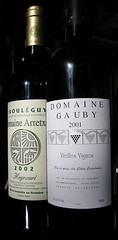
Irouléguy 2001, Hegoxuri, Domaine Arretxea
Vin de Pays des Côtes Catalanes, Vieilles Vignes, Domaine Gauby
Côtes du Rhone 2003, Cuvée Guy Louis, Tardieu Laurent

Wednesday, January 25, 2006


The New Cuvée Marie

Just a quick note for all you white wine sharpies, I tried, um…drank, the 2004 version of the Cuvée Marie yesterday. After last years debacle where the SAQ (assholes) decided to pull the bottle off the shelves due to a slight tartaric acid deposit (ooooh my bottle is dirty), it is a welcomed return.

Very few whites at this price have the aging capacity of this Jurançon Sec, indeed I am still drinking my 1999 and 2000 vintages. The Marie is made with 90% Gros Manseng and 10% Corbu and aged in mostly old wood for 11 months. Manseng brings the structure, a bracing acidity, while the Corbu imparts the finesse. I have always found the acidity in new vintages a touch excessive, so if you insist on drinking from the shelves, give it at least 3-4 hours in carafe. But buyer beware, drinking this stuff will be detrimental to your Chardonnay habit!

Jurançon Sec, Cuvée Marie 2004, Charles Hours ($24.85....saq)
The 2004 has heady aromas of white clover, honeysuckle and juniper berries, but is lacking the nutty oxidative notes of aged Jurançon (maybe I should give it some electrolysis). It is also a touch fruitier than the 02 with notes of fig and lychee, and a touch of sweet spice. Length and elegance as well as an exceptional balance between acidity and richness, this is the perfect wine for all that is spicey…Indian buffets, steak tartare, and even Maggie’s tacos puercos.

Friday, January 20, 2006


Friday Befuddlement
3 Mysteries to Begin my Working Week

#1. Vin de Table, Nature, Marc Pesnot ($20…importation)
Calling all Natural Wine-meisters, I need some more info. What Rezin refers to as the Chapeau Melon comes from Muscadet, is made with Muscadet, but drinks like some far-removed cousin. It is rich, with a hint of sweetness on the finish. The slight 'perlance' is gone after the second sip, it tastes of appeloup, and the red kind at that, with a hint of lemon cream. There is a touch of minerality as well as a hint of scotch, which is expected with a no sulfite wine. No millisème, and except for some heresay about an evening of maceration carbonic, I know nothing. I have already drunk 4 bottles so let me know before they are all gone.

#2. Mark Kramer and the Wine Spec (page 100)
I picked up the Wine of Year issue to research a future post and noticed an article about WS columnist Mr. Kramer espousing Natural Wines and Biodynamics. Comparing the manipulated wines of modernity with a babe who has had too much plastic surgery, and thus becomes painful to look at, Mr. Kramer makes an argument for ‘ ‘real’ ‘wines (extra parenthesis courtesy of WS). Aside from giving exposure to possibly my favorite wine, Deiss’ Schoennenbourg, Mr. Kramer understands the underpinnings of the argument against the overmanipulation of the juice. Maybe there is a ray of hope, but I am still in shock.

#3. Wine of the Year
The only 100 point wine on the list was the Yquem… why did it finish 10th? Am I missing something?