Monday, January 29, 2007

The Boredom-Breaking Mid–Week Meal

Chicken breasts and chardonnay; few ingestibles strike indifference to my palate as much as these two. Chicken breast is a tasteless source of protein and the mere mention of chardonnay always inspires a trip to the basement, and a search for a viable alternative.

The Meal

Chicken Breasts stuffed with Goat Cheese and Basil and a mushroom wine sauce

I found this recipe on Epicurious and it was quick, easy and yes... tasty! I added some roasted garlic and sun dried tomatoes to the goat cheese stuffing and a good mixed selection of wild mushrooms to the sauce. This type of meal requires a white that on one hand is rich enough for the meat and the cream in the sauce, yet has enough acidity to handle what the naturally acidic goat cheese and sundried tomato bring to the table.

The Wine

Cote du Roussillon 2004, Le Ciste, Domaine LaGuerre ($24...importation)

Yet another Grenache Blanc blend (with marsanne, roussane, rolle and macabeu) and yet another superb, organically grown white from the south-west of France. The Grenache and marsanne bring the necessary richness to the blend while the roussane and rolle come with enough acidity to keep the ensemble fresh. The key here, as so often is the case with white wines, was service temperature. As the wine approached 10C (50F), the balance between acidity and richness was perfect, highlighting a nice mineral character, well integrated notes of oak, and an almost haunting bouquet of a field of white flowers.
Unfortunately this bottle, as are many of the best examples from the southwest, is only available on private import. Here a couple of good selections from the region at the SAQ…

Château Les Pins côtes-du- roussillon 2003 , 21,50 $
Bergerie de l'Hortus Classique vin pays val-de-montferrand 2004, 18,05 $

Thursday, January 25, 2007

Mid-Week Meal and
The Benefits of Not Robbing the Cradle


The Meal
Roasted young Guinea Fowl (pintadeau), served with mixed roasted veggies and a roasted garlic, thyme and rosemary cream sauce. The meat of the Pintadeau is dark, lean and a touch gamier than chicken. While I am a card carrying member of WWWeP (White Wine WhEn Possible), because of the Guinea meats color and it’s slightly gamey flavour, I chose to go with a red wine. “Gamier” meats tends to pair well with wines that bring an abundance of fruit to the table (wether it be duck, deer, boar), but since there is so little fat on this bird, I had to look at those wines that have very little tannin and with subtle flavours such as Pinot Noir, Barbera or Gamay.

Gamay?

The Wine

Moulin a Vent 2001, Joseph Burrier, Château de Beauregard ($29...saq)

Few regions of the viticultural world are as misunderstood as Beaujolais. The poor image that they have so deftly cultivated amongst wine connoisseurs has been the result of years of banal “vin de negoce,” and the insipid fruit beverage sold under the banner of Beaujolais Nouveau. But real, properly aged Beaujolais can be a thing of beauty.

Of the ten ‘crus’ of Beaujolais, Moulin a Vent arguably ages best, gaining Pinot Noir like richness and elegance after only a couple of years in the basement. Last nights 2001 confirmed all that is great about Beaujolais. Gone were the slightly one-dimensional candied red-fruits one often associates with young Beaujo and instead, the focus was on kirsch, black cherries, prunes, violets and a seductive aroma of grape jelly (though I couldn’t tell you what kind of grape). The pairing was one of the best I have had in awhile.

We all know the recipe and the stats. People don’t age their wine so winemakers make wine to be consumed almost out of the barrel…Pick late, if it shows any toughness blow bubbles up its ass (micr-ox).. it’s very Rolland-esque. But wine, made in a traditional manner, requires time, and if you allow it to mature, your patience will be rewarded. So, Obama in ‘08? Like any great bottle it’s tempting to go for it now, but he too might need a few more years.

Monday, January 22, 2007

The Myth of Port and Cheese

I once suggested to a client that the only reason to serve a port with cheese is if you completely detest the taste of cheese. Port and a very strong blue like stilton perhaps, but even that pairing is not the best that I have ever tasted. Wether this is a marketing coup by the Portugese, or simply a case of people believing that if it works with Stilton, then it must be great with all cheese, the reality is that of the thousands of cheeses available, very few are powerful enough to hold their own against such a powerful and sweet wine like port. This is also true of most ‘blockbuster’ red wines. In fact, and this might come as a surprise, but the majority of cheeses tend to work better with white wines. Here’s why.

Cheese is made with milk and usually not of the skim variety. The cream in cheese coats our tongues with fat which impedes our ability to perceive flavours. As well, the proteins found in milk tend to harden a red wine’s tannin and increases our perception of acidity. The end result is a muted, slightly acidic taste that will in fact ruin many a red wine, including port. White wine on the other hand, with its inherent fruitiness will benefit from the saltiness of cheese and bring refreshing fruit and a welcomed acidity to the palette.

This is not to say that you red wine fanatics are completely out of luck. As a general rule the harder and drier the cheese, the better chance it will work in combination with a red wine, as there is less creaminess to interfere with the wine’s fruit. Which one to choose depends on the strength of the cheese but generally look for red wines that put the emphasis on fruit instead of tannin such as Beaujolais, Dolcetto, pinot noir, or a juicy, sun drenched grenache. If you want to put your taste buds through a work-out and have a glass of Aussie shiraz or Amarone left over after dinner, try them with a Parmigiano-Reggiano, a well-aged cheddar or Gouda, or a Gré des Champs from Québec.

For the rest, break out the white and laugh knowingly as your guests ask wether they will get headaches if they drink white wine after red (and no, they really won’t). Now which one to choose depends on the cheese in question.

In general, fresh cheese like goat with it’s naturally high acidity work best with equally high acid whites like Sauvignon Blanc. I have also had some success serving an off-dry white port. Creamier cheeses like Brie, Camembert and Riopelle do well with a richer wine like a subtly oaked Chardonnay, Pinot gris, or even a good mousseux or champagne. As we move into soft and semi-soft cheese like Oka, Victor et berthold, Kenogami or Pied de Vent (why not go for just Quebec made cheese?), try a Riesling, Viogner or for a fortified wine like a Muscat de Rivesaltes or medium bodied sherry.

And finally for Blues, try a rich dessert wine like a Sauterne, late harvest gewürztraminer or riesling, or perhaps a sweet sherry. I freaked some people out at a previous tasting with a Pacherenc de Vic Bihl (a sweetie from the Madiran area). They will fare much better than a red based wine, especially with creamier blues like gorgonzola and Roquefort. The rich sweetness of dessert wines makes them compatible with a wide variety of pungent creamy cheeses and earthy, extra-strong hard cheeses.

The more that I delve into the subject, the more I am convinced that each cheese has it’s viticultural soul-mate, so when putting together a combination of different cheeses, try and choose similar types of cheese (ie. Brie and Riopelle). This will not only make it easier to choose the right wine, but it is interesting to also compare the subtle differences between the cheeses. But if you are going to serve the ‘surf and turf’ of cheese plates or are invited over to a ‘wine and cheese’ party, the safest bets are mildly sweet wines like those from the Jurançon, Alsace or my personal favorite, a slightly sweet sherry.

Then what about you beloved port? The number one mix with port, and in particular, Tawny port, is chocolate. Combine a couple of chocolate truffles with a sofa and a fireplace and you have the perfect end to any soirée.

Friday, January 19, 2007


Why Biodynamics is important

Yes, it’s no longer Wednesday, so please forgive my tardiness. As a long standing supporter of bio-dynamics, at times I have had to dig in my heels against a tornado of criticism from the more erudite contingent of the blogosphere. But they have reason, and perhaps even an obligation to doubt, and to question. I agree that the idea of using bladder fermented herbs in homeopathic doses as way of ‘energizing’ your compost is weird. You should also know that there is often a ceremony attached to the burying of the cow horn, the vessel of the fermented herb concoction.

What the doubters are looking for is scientific evidence that these bio-d interventions have some sort of effect, wether it be positive or negative. But that basin of knowledge is still relatively small. From what I have read, there seems to be a consensus that the use of bio-dynamics tends to result in slightly reduced yields, but a healthier and better root development which is probably a result from a greater microbial bio-mass, ie healthier soil. After that, not much. From my perspective, until the long term impact of bio-dynamics versus conventional and organic interventions has been studied, we should take an innocent until proven guilty approach. But that is not really the point.

The real importance of bio-dynamics lies in an important paradigm shift, from humans being the masters of the natural world to that of participants. Biodynamic agriculture is not simply about consuming the resources of the earth, but about healing and protecting the very life forces that sustain the Earth. In light of much of the scientific evidence that points to us as being the culprits in climactic shifts, dead or sick water systems, putrid air which sickens us as we breathe, this shift is essential if we are to make the necessary changes to confront these problems. The question is who here are the real fools?

But what of the wines? Many of the very best and unique wines that I have tasted are in fact a product of bio-dynamic farming. The sceptic will say that it is the extra attention paid to the vine that makes makes for better quality fruit, or perhaps it is the reduced yields. Or, that the wines were great even before the switch to bio-d. That might be the case, but they are great wines nonetheless. So, if the result of switching to bio-dynamics means great wines and a healthier environment, I am more than willing to support these winemakers efforts by buying their wines, and telling others to do so as well. Take a look at Jack's roundup for some other bio-d faves from the blogging world.

A Couple of Bio-d faves from 2006

Clos de la Coulee de Serrant 1998, Joly
An eight year old Chenin that required another 3 days in caraffe to show itself, but very much worth the wait. Such incredible length, almost defines minerality with notes of honey and apples

Bordeaux Côtes de Francs 1970, Château le Puy
To buy a the most recent vinatge costs $25! The is how Bordeaux should be drunk. A generous bouquet that combined herbs, tobacco with a hint of leather was followed by a profound fruitiness that evoked the same bright plum and tart cherry of younger vintages but in a richer and more elegant framework.

Vin de Pays de L’Hérault 2000, Mas Jullien
Composed of a veritable salad of indigenous grapes including Grenache Blanc, Viogner, Chenin, Terret Bourret and possibly even some Gros Manseng, this is big wine with a lot of stuff going on. Apparently his buddy Didier Dagneau of Pur Sang Pouilly fame helps Jullien with the vinification. It had a beautiful floral nose with browning apples, peach and vanilla accents. It reminded me of spring. What followed was one of the creamiest and most complex whites that I have tasted in a while. Terret brings the apples, Grenache a hint of oxidized nuttiness, Viogner that allusion to sweet honeysuckle on the finish. The whole package was framed by a wonderful freshness that apparently comes from the Manseng.

Muscat 2004, Franholz, Ostertag
A very dry, and very unique twist on Alsace Muscat. For a grape whose greatest weakness if often its excessive, sweet perfume, this interpretation combines a restrained bouquet with a complex and rich mouthfeel. Ostertag says that Franholz is his ‘enfant terrible,’ … If all women smelled like this I would be in trouble.

Monday, November 13, 2006


New Languedoc, Old Carignan and Deep Purple

It is home to over one third of all vines planted in France. Yet, how the Languedoc adjusts to world glut in grapes will have a profound effect on its future. Once responsible for massive amounts of low quality grapes, growers in the France’s south have had to make a choice as competition from other countries have made this a less viable business.

Faced with the option of simply pulling out vines, a new generation of winemakers have chosen to make higher quality wines. While lower yields have improved the wines, putting more emphasis on more marketable grapes like Syrah and Grenache have no doubt made them more attractive to today’s varietal conscious consumer. However, this second decision has come at a price.

The Carignan grape, indigenous to the south, has suffered as many growers have switched to Syrah and Grenache. Carignan can do wonderful things if given the opportunity, adding color, structure, depth, as well as dark cooked fruits, licorice and earthy aromas. However, since it is often relegated to the more fertile plateaus where it over produces, it can become rather innocuous.

At a recent tasting of Languedoc wines, the bottles that had appreciable levels of well-grown carignan were the ones that stood out. If you place a value on the importance of regional ‘distinctiveness,’ look for those Languedoc wines with higher percentages of this grape.

Coteaux du Languedoc 2001, Mas Jullien
One of my favourite producers is Olivier Jullien. His estate, Mas Jullien, is spread out over 15 acres around the village of Jonquiers, just north of the Mediterrean coast and the city of Montpellier. I have already reviewed his Mas Jullien Blanc, a six grapes blend that includes Grenache Blanc, Viogner and Chenin Blanc, and to my taste is one of the most distinctive and interesting whites in France that requires years of cellaring to reach it’s apogee.

His red, a blend of Carignan, Syrah and Mourvedre, is no less interesting. Like many carignan based wines, it requires a couple of years of cellaring to iron out some of the rougher edges, but it rewards patience like few wines from the region. This was my fourth bottle (I still have two left).

Drunk to the tune of a big juicy steak.

Deep purple in both color and style. Like Richie Blackmore’s guitar playing, Jullien combines virtuosity with power, beauty without being very pretty. It smells and tastes of dark plums, marinated in licorice and sweet spices. Rich and concentrated, the tannins melted away to a dense, powerful and harmonious finish. This is not the new dulcimer Blackmore, but the Richie of Old.

Wednesday, November 08, 2006

WBW27… Frozen Wine

Vin de Glace 2004, Marechal Foch-Ste. Croix, La Roche des Brises ($42...at the vineyard)

The one thing that Quebec has it’s fair share is cold. And lots of it. Bone chilling frostiness. Wow, I can’t wait. While this has made producing ripe, good quality dry table wines a challenge, it has been no impediment to making great icewines. Led by Marathonien’s victory at the recent Okanagen Icewine Competition (where it’s Vidal bested perennial champions from Ontario), the Quebec wine industries future might be tied to the production of this style of wine.

To vinifera or not to vinifera is the question facing many of Quebec’s wine producer’s these days? While small scale wineries can afford to bury the vines each winter, larger operations have seemed to pin their future on working with hybrids. Well, if you doubt that hybrids can make a great wine, then you haven’t tasted the latest offering from La Roche des Brises. Unique in that it is Quebec’s first “red” icewine, this Foch and Ste-Croix assemblage combines the aromatics of a black Muscat with the delicate flavours of a Niagara Cabernet Franc. With only 147 grams of residual sugar, it isn’t too sweet so it can work with a host of desserts. We, a table stocked with sommeliers, drank it last night with a chocolate fondue, and it worked superbly. It’s caramelized , nutmeg infused plum and fig flavours, when overlayed with the chocolate was as you can imagine, deliriously good.

And again, made in Quebec.

Thanks to the kitchen chick for well, doin it.

Tuesday, November 07, 2006

What do you want to know about the wine you drink?

As a full-on info glutton, I am often frustrated about the lack of information available about many of the wines that I drink. Labels, which the rest of the food and beverage world use to list ingredients at their very best will list percentages of each varietal used in making the wine. More often than not, they are dedicated to drawings of small animals or are poorly written tomes describing how ‘x’ wine is a perfect accompaniment to anything from dry turkey to grandma’s overdone roast. They should at a minimum be forced to write this stuff in ‘haiku.’

But what should be written on these labels and what info should be readily available to the interested consumer? The demystification of wine begins with knowing what grapes we are drinking and where they are grown. If the Napa Cabernet I’m drinking in reality contains“x” percentage of another grape, is in part sourced from a different area, or blended with wines from previous vintages, then why is this reality not reflected on the label.

And what about the processes, ingredients and other details about how a wine is made? Aside from a warning that the wine contains sulfites, which is relevant to but a small percentage of the drinking population who have such intolerances, little is divulged. When I have questioned people in the wine industry, the response has been that nobody really wants to know about this stuff, or that “chemical sounding names” will just scare people off, or my favourite, that they are ‘trade secrets.’ Coke and twinkies don’t reveal everything, do they?

Bullshit. I have read enough tech sheets and talked with enough winemakers to know that wineries are happy to divulge lots of info about their wine. Maceration time, the duration, temperature, and type of fermentation, wether they use whole bunches, the type of press used, yields, the list goes on and on. But ask them about the use of colorants, or the addition of tannin, tartaric acid, sugar, water, or wether it’s been de-alcoholized, and they are much more retiscent. If you are one on one with the winemaker, perhaps you will get a hushed response.

These manipulations are as important in making a wine as much of the above mentioned processes that they are willing to talk about. I am not out to embarrass people, I just want to know what went in to making the wine I am drinking.

And to those winemakers who embrace this technology, let me taste the wines with the full knowledge that they are products of these manipulations. If they are as good as the rest, I’ll buy them and tell others to do so as well. Their silence just perpetuates the sceptic in me.

This type of disclosure, wether it be on the label or on the wineries website will just serve to educate the drinking population. The best winemakers use intuition and instinct to make their wines. It is an art form and even if Picasso told you all about the exact color mixes he used, few people would be able to copy him. And those who could, wouldn't. Where the problem lies are are the Enologix type of winemakers who follow recipes, to create wines which match flavour profiles using whatever technology that is available to them. I see this as a threat but that is a topic for another day..

Monday, October 30, 2006

A Really Great Wine

One of the reasons that I do what I do are the wine tastings. I used to revel in these moments, looking forward to each with the anticipation of a kid running home Halloween night with a bag full of candy… oh, which one will I gobble down first?

But more and more my bag is overflowing with the same candy. Recent tastings have left me wondering wether those harbingers of doom (me included) were right; we are moving with giant steps towards a uniformity of taste, adorned in Chairman Mao grey sporting both little hats and stars.

But then there was Tissot. The Jura has been able to resist for the moment the group goose step. No one talks of Parker’s influence here and Michel Roland doesn’t have a consulting gig. Perhaps the wines are just too weird to begin with, or perhaps it’s a confidence that’s rooted in tradition and heritage. Jura wines are always distinctive, and often very good.

One of these is Stephan Tissot’s 2004 Traminer. First tasted with Beau at last year’s Salon des Vins, I finally got an opportunity to drink a bottle.

Arbois 2004, Traminer, Domaine André et Mireille Tissot (vins alain belanger ....$25)

Made with gewürztraminer related savignan, this is an Arbois for all. Responsible for the somewhat eccentric Vin Jaune, a sherry like white which often scares the uninitiated away from the region for good, the savignan here is treated differently. Where the vin jaune is matured for 6 years and 3 months under an oxidizing film forming yeast called a ‘voile,’ this savignan is vinified with ‘ouillage.’ Ouillage means that the casks are continually topped up, replacing the evaporated wine which prevents the development of the voile, thus preserving the fruity character of the wine.

I don’t often go for tasting notes but the aromatics of this wine blew me away. I spent a good 15 minutes swirling and sniffing, as did a number of us at the table. Blue-haired Joe said it reminded him of October in an apple orchard on a cool, dewy morning. I found at the core ripe Santa Clara plums, along with sweet honey-suckle. The acidity balanced a formidable richness to perfection that makes this a wine with a host of possible pairings (I kept thinking oysters Rockefeller).

In this age of so much sauvignon, and shit loads of Chardonnay, it is always refreshing to have an alternative. As Beau put it, find it and snatch it up right away.

Wednesday, October 25, 2006


What Was Said....

'...intelligent...'
-Wall Street Journal Oct 23, 2006

'... holistic...'
-Wall Street Journal Oct 23, 2006

'.... practical...'
-Wall Street Journal Oct 23, 2006

'... better than CATS!'
-somebody else

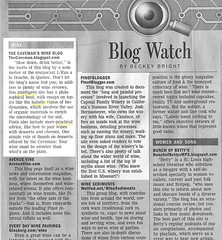
So how cool is that? Monday's Wall Street Journal mentioned my little blog alongside Pinotblogger, Avenuevine, Wine Sediments , Everyday Wine Pairings, and Mag's little irreverent ode to boisson, Wine Offensive. With this benediction brought thousands of new visitors and hundreds of new subscribers. So to all of you who are new readers, welcome!

Of course this means that I now have full licence, and perhaps even an obligation, to rework some favorite posts of the past year (yes, I am slack but what do you expect for free!). So , in honor of the WSJ, here is one of my faves...enjoy and welcome aboard.

Stop Drinking (bad) Corporate Wine!

Tom pointed to an ‘interesting’ article written by Jennifer Rosen defending ‘corporate’ wine. Defending it against whom I am not sure but the crux of her argument posits that this inexpensive ‘corporate’ wine, which is as familiar and as regular in quality as toothpaste, brings more drinkers into the marketplace. In the same breath, she seems to characterize those drinkers who expect more from their wines as neophytes and epiphany seekers, while the ‘clueless masses’ seem to want some sort of ‘bland’ drink that is as ‘reliable and cheap’ as Coke (quality notwithstanding). To paraphrase a paraphrasing blog buddy, her logic seems to suggest that to make wine accessible we must have more shit wine available.

Oh those poor, stupid, taste-deficient masses.

Well, wine is not coke. Unfortunately, there seems to be some underlying sentiment amongst certain in the industry to treat it as such; just another spoke in the wheel of the beverage industry. Perhaps I am being nostalgic and sentimental, but I still want my wine to be made by someone who grew and pressed his own grapes, and whose wine ultimately carries his signature and some sense of place. It might be quaint but there is more often than not a measure of authenticity about the final product that differentiates it from the yellow tails, little penguins, and other mass-produced, ‘brand’-oriented wines that fill supermarket shelves. Rosen makes the point that many of these more ‘artisanal wines’ are ‘perfectly dreadful,’ I agree, some of them are. But on the whole I find most of these wines more interesting, and at least not disgusting.

I have tried these price-point wines on a number of occasions. I am usually unimpressed, sometimes horrified and rarely surprised. My most recent foray into what Ms. Rosen refers to as ‘corporate wines’ was a tasting of Southcorp (Foster’s) ‘Little Penguin.’ The Chardonnay reminded me more of coconut tanning lotion than white wine, and the Shiraz was closer to Robitussin (without that excellent muted buzz). But this is a question of personal taste. I neither buy nor drink these penguin wines, as I won’t most of the cheap wines presently on the market. This is not because they are made by some massive, unfeeling corporate monolith, it is simply because they taste bad.

But, as children who were raised to believe that garlic-flavored popsicles are good, Rosen claims her ‘blandies’ expect nothing more than the ‘Tzatziki pop’ of wine and are thus happy and comfortable in their ignorance. This is bullshit. It is rare that I have not been able to take a person who has drunk only cheap wine and showed them that, for a few dollars more, there is a better option. And the majority of the time, they can taste the difference. Ultimately it is a question of priorities. It isn't that different from spending that extra 20% on organic produce, for it too is often better than the cheaper industrial produce which fills the aisles of your local supermarket.

It just so happens that these super-cheap wines, which are made affordable because of the economy of scale, are often below the threshold of what smaller wineries can afford to produce. I will not even get into how they are made. But for a few dollars more (at least here in Quebec), there exist a plethora of interesting wines from the world over, many made by co-operatives and good, independent winemakers. By supporting these smaller producers, we are supporting diversity, independence, and frankly they need the cash more than the big corps.

The reality of the modern wine industry is that there are fewer and fewer independent winemakers. Cheval Blanc, Etude, Ornellaia, Yquem, Penfolds, Coldstream and a vast majority of the better wine producers worldwide are now part of corporate portfolios. Like in any industry, there are good corps and bad ones. Those which recognize and continue to support the ‘artistry’ of winemaking and have not become complacent with quality deserve our continued support. Ms. Rosen’s characterization of corporate wine as cheap wine is an insult to many of the better corporations which continue to produce great wines. Her article should have been entitled ‘in defense of cheap, mass-produced wine,’ but even then, I don’t agree.The real danger of the big corps with large alchohol and wine portfolios lies more in the distribution end of the industry. It is here where smaller producers and distributors face increasingly difficult challenges and it is here that they need our support. So get off the kangaroo, seek out the independents and ultimately tell your friends to spend a bit more for their bottles, you will be doing both the industry, and your friends, a lot of good.

Monday, October 23, 2006


The Sommelier Experience

Ordering a bottle of wine in a restaurant can be an intimidating task. The food is ordered, and all eyes shift to you as you leaf from page to page in what you see as an unnecessarily long wine list, quietly hoping to come across a bottle that you recognize. Where’s that Brouilly or Yellow Label when you need it? As befuddlement becomes desperation, the sommelier arrives.

As a sommelier, my job is to demystify wine. In the few minutes that I spend at your table, I have to assess what style of wines you like, what you are willing to pay, and walk that fine line between what you want and what I feel you need. With a point of my finger and a nod, I can make you a hero with the right choice, or I can be your scapegoat if everyone hates it.

But who are these people, why should they be trusted?

The Dinner Table Maestros

I admit to having forgotten the year that my daughter was born, though I remember wines that I drank 10 years ago, with whom, at what temperature, and with what. I am the Rain Man of the food and beverage world. While the majority of sommeliers have arrived at their present occupations via some sort of wine schooling, I have never taken a course on wine. My education was in the kitchen, the tasting room and at the table. It is this equal reverence for both food and wine that separates the wine connoisseur from the best sommeliers. We don’t make either, but we have to understand both. In this sense we are like maestros, trying to create harmonies between what the chefs create and the wines we have at our disposal.

Spit or Swallow?

But we are first and foremost experts on wine. To that end, when I am not working the floor, placing orders, hucking cases, taking inventory and updating my wine list, I am tasting wines. This is the most romanticized aspect of the job, but as much as I try (often in vain) to get some sympathy, the reality is that it is still work. If I taste thousands of wines every year, there are only a few hundred that I actually order. The number of times I have had to smile with red tainted teeth, my mouth as dry as the Sahara, and find something nice to say about yet another wine that I know I will never order.

And to answer that most asked question, most of the wine I am served ends up in the spittoon, except for the really good ones where I sometimes go back for seconds.

The Language of Wine

While we sommeliers know a lot about wine, we do tend to speak our own particular dialect. The language of wine aims to find a way to compare one wine with another. It uses flavours, smells, textures and colors that we find in our glass to references found in our day to day lives. But these associations often don’t resonate with the majority of people who can’t find the ‘dark cherries, summer truffle nor the leather’ that we so cleverly found with a snort and quick swirl of our tasting glass.

Most people have a hard time communicating what they like in wines. The best way of letting me know is by remembering the names of some of your favorite bottles that you drink at home, but most people don’t and end up citing ‘Château … something.’ That must be the best selling bottle worldwide.

In an effort to bridge the communication gap and reach out beyond these staid and conservative descriptions, I have been known to compare certain Californian wines, for example, with the stereotypical beach bimbo (or the male ‘mimbo’ version); easy to like, the first glass is great but lacks the depth to be interesting in the long run. It is remarkable how many clients know exactly what I am talking about.

The ABW and the Curse of the Blue Nun

So now that we know where each other is coming from, it’s time to make our choice. The first thing I must establish is if you are part of the ABW (Anything But White). As a devoted white wine drinker, I am constantly amazed by people’s reticence to quaff a bottle of white.

It’s not your fault. I blame it on Blue Nun and other cheap white wines. If cheap red can be a heady proposition, inexpensive white can be near fatal. We have all had misadventures resulting from drinking one glass too many of some dubious white. It can be a Sisyphean task to battle against such distasteful memories, especially when one considers that the majority of foods work better with white.

Aside from finding the perfect Australian red for your lobster, there is one other thing that I can’t do. I don’t set the policy on pricing and while I understand your frustration that the bottle you want is two and a half times the SAQ price, as much as I would like to, I am not here to negotiate.

Getting the Most out of Your Sommelier

Here’s a hint, when a sommelier says that you should drink what you like, what he or she is really saying is that the wine that you want doesn’t go at all with your choice of menu. I am always amazed how people will give ‘carte blanche’ to the chef to create their dishes as they see fit yet can be relatively narrow minded in their choice of wines. So if you are lucky enough to have a sommelier at your restaurant, come with a sense of discovery, get out of your comfort zone and try something new.

I fear no client more than the wine collector who loves to list every wine he has drunk or the entire contents of his cellar. Nobody likes a snob and we sommeliers are a difficult lot to impress. Wine and the way it works with food can be fascinating, but it must be put into context. I see wine as a spice, a luxurious accessory to complement our meal. But in the grand scheme of things, that we can spend a couple of hours worrying over such ephemeral pleasures should remind us about what is really important.

That we are indeed very fortunate people.